In the Chapter on Right View, under the subheading of ‘Superior Right View’, Ven. Bhikkhu Bodhi writes the following passage as part of the justification for the two kinds of right view and why ‘Mundane Right View’ alone isn’t sufficient for liberation.
*“The right view of kamma and its fruits provides a rationale for engaging in wholesome actions and attaining high status within the round of rebirths, but by itself it does not lead to liberation… There is nothing within the logic of kammic causality to impel the urge to transcend the cycle of kamma and its fruit. The impulse to deliverance from the entire round of becoming depends upon the acquisition of a different and deeper perspective”*
When I first read the book a few years ago, I accepted this passage completely (as I did the whole book).
But later with my sutta study deepening I learnt of MN 57 which has the following extract spoken by the Buddha (translation by Bhikkhu Sujato) -
“*Puṇṇa, there are four kinds of action proclaimed by me after realising them for myself with direct knowledge. What are the four? There is dark action with dark result; there is bright action with bright result; there is dark-and-bright action with dark-and-bright result; and there is action that is neither dark nor bright with neither-dark-nor-bright result, action that leads to the destruction of action…*
*… And what, Puṇṇa, is action that is neither dark nor bright with neither-dark-nor-bright result, action that leads to the destruction of action? Therein, the volition for abandoning the kind of action that is dark with dark result, and the volition for abandoning the kind of action that is bright with bright result, and the volition for abandoning the kind of action that is dark and bright with dark-and-bright result: this is called action that is neither dark nor bright with neither-dark-nor-bright result, action that leads to the destruction of action. These are the four kinds of action proclaimed by me after realising them for myself with direct knowledge.*"
I infer the extract from MN 57 to mean that within the logic of kammic causality there is sufficient reasoning and explanation to justify the “urge to transcend the cycle of kamma and it’s fruit”.
There are a lot of learned people and teachers here and I wanted to know if this discrepancy is real or is it a misinterpretation on my end! I would be grateful for your time. Thank you!
As long as the noble 8fold path is not there it is incomplete. And in many other suttas, right view is defined as the 4 noble truths, which also contain the noble 8 fold path as the 4th.
The neither dark nor bright kamma is exactly the noble 8fold path. That’s the kamma that leads to the ending of kamma.
Other religions can have the same mundane right view of the 10 points, especially like close Indian religions. But without the 4 noble truths, the teaching unique to Buddhas, then there is no ending of suffering for them.
I don’t consider myself a teacher of Buddhism let alone a learned one, but I’ve read Bhikkhu Bodhi’s book for years now and know the section on mundane and supramundane right view you’re referring to.
Simply put, supramundane right view would be the final of the four types of action from the sutta: neither dark nor bright action that leads to neither dark nor bright result. In other words, the end of karma.
Mundane right view would be the first three. Those focused on the first three and not the destruction of action would likely not attain liberation because of their focus on karmic action, theoretically speaking.
I still would not say one couldn’t attain liberation with mundane right view because I’m not an expert and the mind is powerful, nuanced and subtle.
I look forward to hearing from those more qualified to answer your question. Thanks for sharing.
I think that Bhikkhu Bodhi’s message points almost directly at the passage you’ve presented. It’s one thing to know the theory of the law of Kamma and to use this knowledge for inspiration, but as the Buddha points out (and what Bhikkhu Bodhi refers to as super mundane right view), is there is a difference between knowing because you have been told about something, and knowing because you have first-hand experience with the subject itself; you might understand the causal relationships the Buddha points out from a theoretical perspective, but you will not achieve liberation without having personally experienced and known it for yourself. I think this idea is central to the teaching.
I agree with what you say and I do certainly believe that the supramundane right view of the 4 noble truths is an essential condition for liberation. The very hard distinction between the mundane and supramundane right views, and especially the statement “There is nothing within the logic of kammic causality to impel the urge to transcend the cycle of kamma and its fruit” was a bit too strong and did not sit well with me.
I feel that the understanding of the 4 kinds of kamma is essential to the full understanding of kamma (this might be too strong of an assumption from my end, perhaps!). And therefore a full understanding of kamma does provide an urge to transcend kamma even though it definitely isn’t sufficient to bring an end to kamma on it’s own. A supramundane right view of the noble truths is essential.
I felt the distinction between the two kinds of right views isn’t that strong and they are more of a continuum.
Having mundane right view is good kamma, not bad or mixed kamma.
Explore a bit of Hinduism and Jainsm, they have kamma, rebirth, but not the full noble 8fold path. If one is not well versed, one might lump Buddhism in with them and call it continuum of Indian religions.
But it is the claim of Buddhism that the noble 8fold path alone brings to enlightenment, believing kamma and rebirth are true is merely an essential backdrop. So the noble 8fold path is very unique in this regard.
So much so that the richest lay follower back then felt moved by just hearing the word “Buddha”. That the final end of rebirth was discovered is no small feat.
I think only Bikkhu Bodhi himself can explain what he meant when he penned this statement.
I can’t remember which talk or where I might’ve read the explanation, from what I understand by “action that is neither-dark-nor-bright” is from someone who has a certain level of attainment, so in other words a stream-winner, once and non-returner.
I believe that’s why Bihhku Bodhi says:
Once someone has entered the stream (seen the 4 Noble Truths), they naturally have a deeper perspective.
So until we’ve reached that point, we need to aspire to make “bright actions with bright results”.
Because these good actions are a “support” for us, so we have the right conditions to keep practising the N8FP. Until we’ve reached stream-entry, we’re not safe, there is still the possibility of being reborn in the lower realms, where we can’t practice the Dhamma.
If you think about it, someone who doesn’t have that “deeper perspective”, in other words a puthujjana or unenlightened person, they won’t have that intention (neither-dark-nor-bright), because they haven’t yet reached that deeper level of understanding.
Edit:
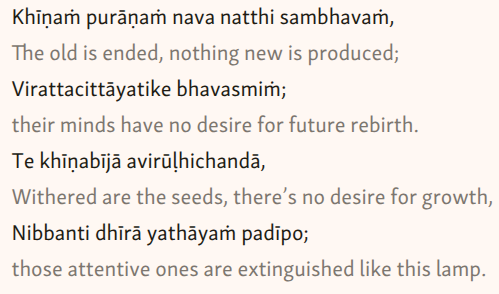
I believe these verses from the Kp6 Ratanasutta, encapsulate the meaning of “neither-dark-nor-bright” kamma and results.
See, for example, Karma and Rebirth in Early Buddhism by J.P. McDermott.
If kamma is, fundamentally, an operative principle that explains how past deeds influence rebirth, then I can understand how seeing kamma isn’t liberating in and of itself.
Yet I find it massively inspirational. I love contemplating kamma.
I agree that the buddhist path of practice is a continuum, especially today when there is so much ignorance. There aren’t many I hear of attaining sudden release.
I say if you practice right you can reach full release and will understand all the teachings even without having knowledge of them. These distinctions do not really matter.
For me, study and discussion is largely a way to gain energy, perseverance, effort, motivation, etc. One of the seven factors of awakening.
Yes, but if having mundane right view is itself bad kamma, would Buddha encourage us to have mundane right view in the first place?
The meaning of kamma being one of the unthinkables is exactly which action produces which results, not the general principles which are abundant in the suttas.
Does sound like a case of “you can’t get there from here”.
Gautama seems to advise relinquishing action toward the “there”, toward the transcendence of kamma.
That leaves us with “here”. Some “here” fun from the Ch’an world:
You must strive with all your might to bite through here and cut off conditioned habits of mind. Be like a person who has died the great death: after your breath is cut off, then you come back to life. Only then do you realize that it is as open as empty space. Only then do you reach the point where your feet are walking on the ground of reality.
(“Zen Letters: Teachings of Yuanwu”, translated by J.C. and Thomas Cleary, p 84; emphasis added)
People who have died the great death are all free of the Buddha-Dharma, free from its principles and its abstruseness, free from gain and loss, right and wrong, merit and demerit; they have reached here and rest in this way.
(Yuanwu’s commentary on the 41st case in the Blue Cliff Record; tr. “Critical Sermons of the Zen Tradition: Hismatsu’s Talks on Linji”, p 155; emphasis added)
So, not “a different and deeper perspective”, but rather a simple presence of mind “here”. The thing about that is, “here” is not fixed:
Self-location—the sense of where I am in space—provides an experiential anchor for one’s interaction with the environment. … many researchers have defined self-location solely in terms of body-location—the subjective feeling of where my body is. Although this view is useful, there is an issue regarding whether it can fully accommodate the role of “first-person perspective”-location—the sense of where my first-person perspective is located in space.
… under experimental manipulations, one’s sense of “first person perspective”-location could be separated from where one’s eyes are physically located in space.
… Based on our findings, we suggest that, instead of defining self-location only in terms of body-location, the sense of self-location can be better characterized as the subjective experience of where I am in space that results from the interaction between body-location and “first person perspective”-location.
When you find your place where you are, practice occurs, actualizing the fundamental point.
(“Genjo Koan [Actualizing the Fundamental Point]”, tr. Kazuaki Tanahashi; emphasis added)
“Your place where you are” is your “embodied self-location”:
A key aspect of the bodily self is self-location, the experience that the self is localized at a specific position in space within one’s bodily borders (embodied self-location).
(Journal of Neuroscience 26 May 2010, 30 (21) 7202-7214; emphasis added)
I would contend that “self-location (as) the subjective experience of where I am in space” is “one-pointedness”:
Herein… the (noble) disciple, making self-surrender the object of (their) thought, lays hold of concentration, lays hold of one-pointedness. (The disciple), aloof from sensuality, aloof from evil conditions, enters on the first trance, which is accompanied by thought directed and sustained, which is born of solitude, easeful and zestful, and abides therein.
(SN 48.10, tr. Pali Text Society vol V p 174; parentheticals paraphrase original)
What to do, what to do, put some peanut butter in my shoe!
… just as a handy bathman or attendant might strew bath-powder in some copper basin and, gradually sprinkling water, knead it together so that the bath-ball gathered up the moisture, became enveloped in moisture and saturated both in and out, but did not ooze moisture; even so, (a person) steeps, drenches, fills, and suffuses this body with zest and ease, born of solitude, so that there is not one particle of the body that is not pervaded by this lone-born zest and ease.
(AN 5.28, tr. PTS vol. III pp 18-19, parentheticals paraphrase original)
These are the states in which kamma ceases:
…I have seen that the ceasing of the activities is gradual. When one has attained the first trance, speech has ceased. When one has attained the second trance, thought initial and sustained has ceased. When one has attained the third trance, zest has ceased. When one has attained the fourth trance, inbreathing and outbreathing have ceased… Both perception and feeling have ceased when one has attained the cessation of perception and feeling.
it is a plain fact that “There is nothing within the logic of kammic causality to impel the urge to transcend the cycle of kamma and its fruit”, because the knowledge of kamma is not a liberation knowledge. the causal effect, is a universal law, understanding this law is irrelevant with liberation from the universe, and the universal laws including the law of aging and death.
the liberation knowledge is about how to server the citta from worldly bondage, this bondage is termed as defilements subjectively as rāga, dosa, moha. it is to untie the knots that locked the citta inside this world, the knots, fetters, …how to overcome them, these are liberating knowledges, beyond the knowledge of kamma.
Surely the Buddha knew practitioners had a mix of kamma both dark and bright. Not many arrive at buddhist practice with nothing but bright kamma. I have both dark and bright kamma and I’ve been practicing for years.
I think the culprit is the ambiguous wording of this.
You meant it as mundane right view is saying that there’s results of good and bad deeds as mundane right view is talking about bright, dark and mixed kamma.
I took it as having mundane right view is itself a good kamma. As Buddha did said those who have wrong view has either animal realm or hell as the next destination.
I’m thinking people with mundane right view have mixed kamma and often commit good and bad actions.
I don’t put too much importance into such distinctions. I try to focus on the practice. I don’t have or want the ability to judge. That’s for powers beyond me.