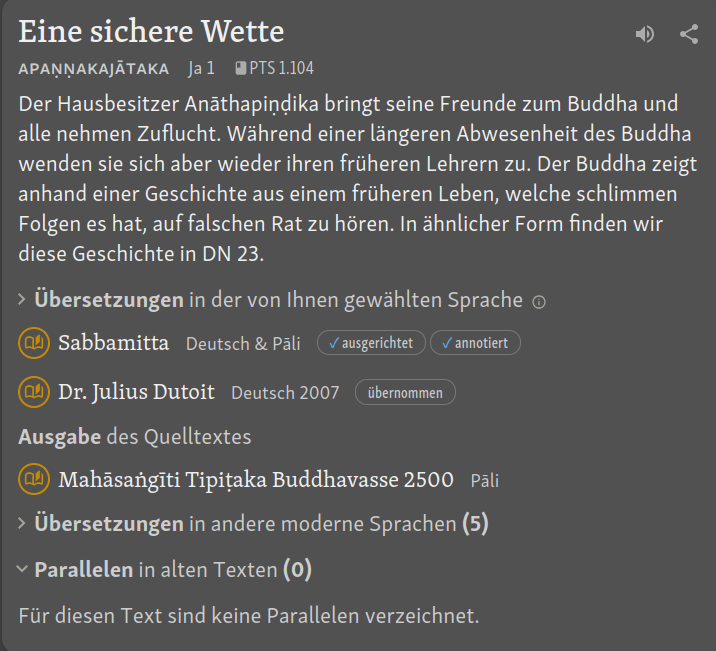
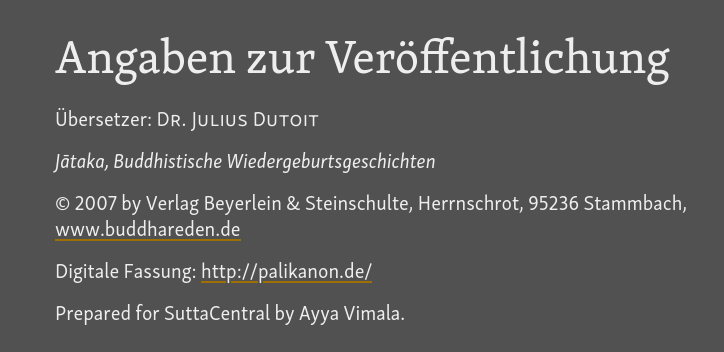
The translation date is given here as “2007”. By that time, Dutoit was dead for about 50 years. The actual translation date is 1908 (according to https://palikanon.com/khuddaka/jataka/j00.htm as well as http://www.palikanon.de/khuddaka/jataka/j00.html):
Yes, the code pulls the date from the copyright. It is not the date of the translation. This is true across the legacy texts. It isn’t a bug. It may not be good, but it’s not a bug.
In any case it creates a wrong impression for the user. In the case of Bilara translations you see the translation date, and in the same place, in the case of legacy translations you see the copyright date—and there is no way for the user to know the difference.
Which category does it belong to, if it is not a bug?
The thing is, Bilara has not copyright date, and with legacy translations there is no way to know when the translation was done. So it’s apples to oranges. Even the Bilara date is just when the first translation was published, no? Not the date of last updates?
I guess ideally legacy texts should have both copyright and translation date. As far as I understand, it could be inserted somewhere (like in the HTML and then collected by the ETL into the DB), it’s just not currently tracked, right?
As in, it’s a legacy design problem, but it could be corrected, no?
Although I’m not sure how rare it is that a copyright date doesn’t match the translation date, especially as significantly as this case
For Bilara texts, I did mention in another thread that it might make sense to have both original publication date and a “last updated” date.
I am a bit curious how a work from 1908 got a copyright almost 100 years later I assume they made some form of copyrightable derivation, but that makes me curious too!
The original would be public domain normally at that point.
I’m also not very knowledgeable about German copyright nuances compared to US copyright, that being said (although the broad strokes are generally similar internationally, and seem to align in this case, as far as I could tell from a quick search).
I cannot tell exactly, but I guess the current publisher took it over after the original editor doesn’t exist any more. I don’t know at what point the Lotus-Verlag gave up, though; there was likely a gap between the two.
I think Beyerlein took it over in 2007 in order to make it available again. I guess copyright wasn’t expired yet at that point (copyright expires 70 years after the original owner dies; Dutoit died in 1958). In any case, this publisher isn’t about profit at all. It’s a one person company who’s aim is mainly to make the Buddha’s teachings and the existing German translations available and to do as much for the Dhamma as he possibly can.
The data doesn’t exist in the legacy texts. It would have to be added. And there are a lot of legacy texts. And I doubt it would be easy to even decide what date to use.
Personally, I’ve just decided that if I really want to know about a text I will have to research it myself.
You can do that because you know the background of the dates shown. But most other people would just take the date as given and reliable … so to me, there is still a problem. But I agree it is not easy to solve.


 I assume they made some form of copyrightable derivation, but that makes me curious too!
