We normally take the westernmost extent of the reach of Buddhism to be around Delhi, the Kuru country where the Buddha taught the Satipaṭṭhāna Sutta. Of course, there are many unknown places in the Suttas and it is possible the Buddha or one of his disciples went further.
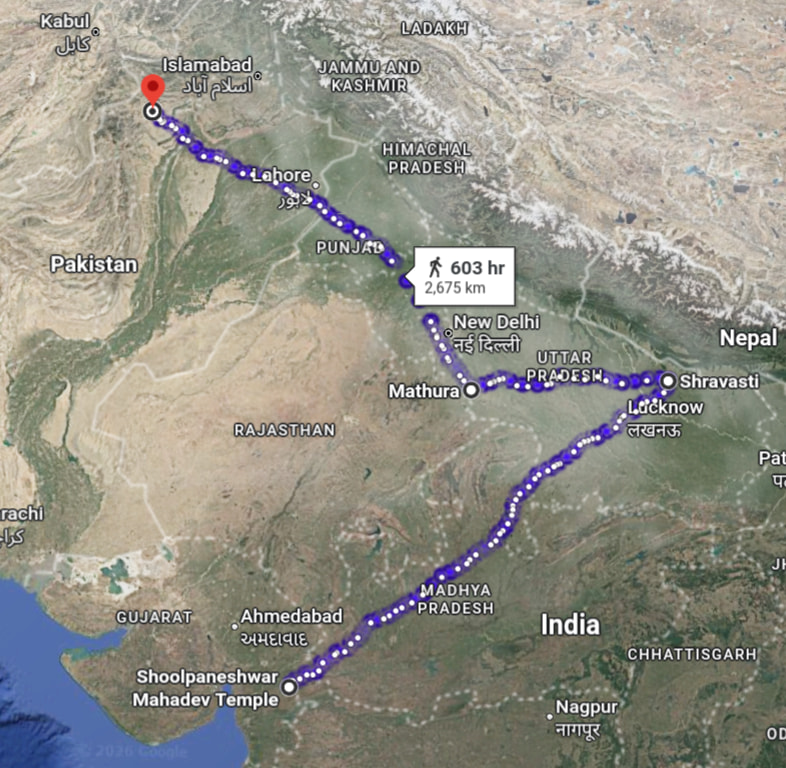
Mahākaccāna was one of the Buddha’s students known for his travels. He eventually settled in Avanti, about 1000 km south-west of Sāvatthī, and we also meet him in Mathura, about 500 km due west of Sāvatthī (AN 2.38, MN 84).
But perhaps he traveled even further than that. Mathura lies on the northern road that reached up to Gandhāra, Kaśmīr, and the Iranian-speaking land of Kamboja. All these lands west of the Indus were under Persian control during the time of the Buddha.
AN 2.37 finds Mahākaccāna in an unidentified location with a place and a river or lake. The Sutta itself tells us that Sāvatthī lies to the east, which, given that the next Sutta is set in Mathura, suggests these two episodes may have been on the same journey, and that here he is western India. How far west are we talking about?
Varaṇā
The town or district is called Varaṇā, which appears only here in Pali. It is perhaps the same as Xuanzang’s Varṇu or Varaṇā (Buddhist Records of the Western World 11.23), known as Varṇu by Pāṇini (4.2.103), and in Avestan as Varəna.
Cunningham (The Ancient Geography Of India, pp. 71–73), confidently identifies Varaṇā with the modern town of Bannu in Pakistan.
The Zend Avesta describes Varəna as “four-cornered”. The translator Darmesteter regards it as originally a heaven, and connects it with the god Varuṇa, who is associated with waters. Of course it is normal that divine and earthly locations are intermixed.
Here’s a screenshot of the topography of Bannu. It’s in a large basin surrounded by mountains, and I think it’s well-described as “four-cornered”.
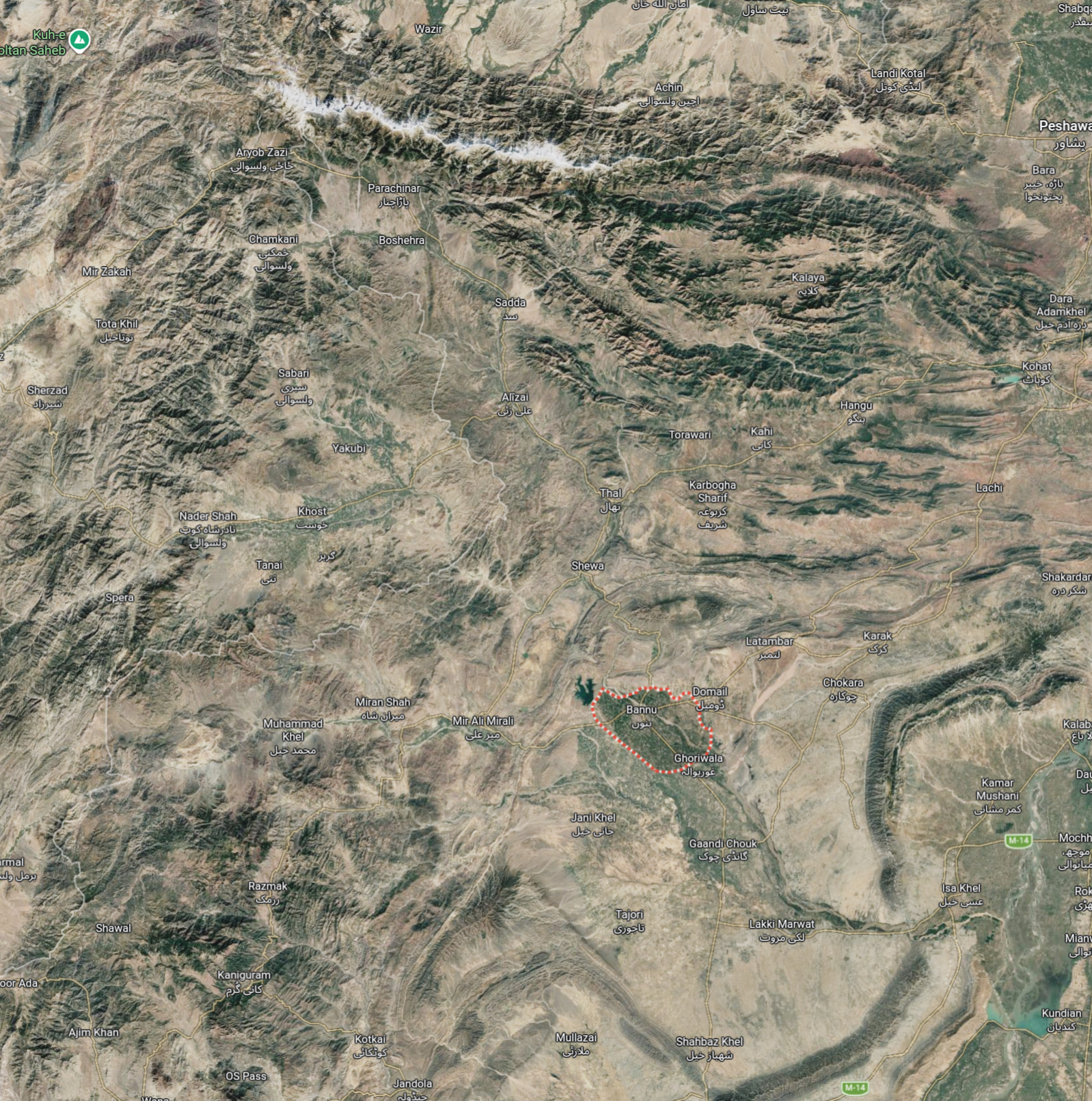
Wikipedia says:
The history of Bannu goes back to prehistoric time, due to its strategic location along the Kurram and Tochi routes which lead into the Indus Valley. Sheri Khan Tarakai is an ancient settlement site located in the Bannu District with ruins of the oldest known village settlement in the Bannu region, which was occupied from the late fifth until the early third millennium BCE. Recent archaeological excavations at Akra, Bannu showed that it was a large urban site that existed throughout the Iron Age and had trade relations with Central Asia.
Kaddamadaha
Kaddamadaha means the “Muddy Lake” or perhaps, the “lake on the River Muddy”. It too also appears only here in Pali. Some manuscripts have the prettier bhaddasāri, “fair-flow”, about which I cannot find any information.
Kauṭilya mentions the Kardamā as a river that produces pearls (Arthaśāstra 2.11.2), which its commentator says is in Persia (Trivedi, Harihar V. 1934. “The Geography of Kauṭilya.” Indian Culture 1: 251–252).
The modern town of Bannu lies beside the river known today as Kurram. The linguistic variations of rr/rd/dd and u/a are common, as is the dropping of the final vowel, so this may well be the Kardamā of Kauṭilya or the Kaddamā of the Pali. It is Kwarma in Pashto, and sometimes identified with the Krumu, which is a tributary of the Indus in Rig Veda 5.53.9.
This flows from northwestern Pakistan, past Bannu, before descending to the plain and joining the Indus near Isa Khel after a course of more than 320 km.
Conclusion
Obviously none of this is definitive. Bannu lies about 1000 km north-west of Mathura, or roughly 800 km from the Kuru country. It’s a long way, but we know that Mahākaccāna did in fact undertake journeys of this length.
Put it this way. We know that not long after the time of the Buddha, by Ashoka at latest, there were Buddhists throughout the north-western region. As they journeyed there, it would be only natural for them to follow the well-established trade routes beside a river up from the Indus. So it’s very likely, practically certain, that Buddhist monastics did, in fact, visit this area and stay at Varaṇā, modern Bannu. The question is when, and whom.
If my identification is correct, then we can say that the Pali canon depicts Mahākaccāna in Pakistan during the Buddha’s life, extending the reach of Buddhism at that time by around 800 km.
Now, here as in Mathura and in Avantī, we see Mahākaccāna engaged in conversion narratives with local brahmins. It is not unreasonable to suppose that, since he was known for his success in Avantī, the redactors placed him in the north-west to fulfil the same role. It’s also not unreasonable to suppose that a monk who enjoyed traveling and intellectual conversation should have undertaken more than one long journey in his life.
Personally, I find the confluence of the two places, both in the far west, unlikely to be a coincidence. I think Varaṇā on the Kaddamā is in fact Bannu, and I think Mahākaccāna likely visited there. This makes him, as well as his accomplishment in analytical teachings, and his founding of Buddhism in Avantī, the greatest traveler of early Buddhism, and the first pioneer of the Dhamma in the region known as Uttarapātha, then Gandhāra, Kaśmīr, and Kamboja, today known as Pakistan and Afghanistan.
Here’s his whole travels. Google says it’s 2675 km, which might take maybe 4 months. I mean, I couldn’t do it!