I have finally finished my Pali textbook for beginners

Hello everyone! Today I am pleased to announce I have finally completed my Pāḷi Textbook for beginners. (Disclaimer: please note - this textbook was started a few years ago and therefore is not written using AI, however for transparency purposes I have used AI to check and validate some of the contents and to correct my spelling, grammar and formatting errors). This post was not written using AI and AI has not been used to edit the post.

For those of you who don’t know about Pāḷi, it is supposedly the language the Buddha originally spoke and taught in. It is preserved in the Tipiṭaka (the “three baskets”). Modern scholars believe the version that is preserved may be an amalgamation of three Prakrit dialects plus heavy Sanskritisation, rather than what the Buddha truly said, but nevertheless this is the closest we have to what he might have actually spoken.

When I first started learning Pāḷi a few years ago (from @sujato in this forum), I did not like any of the popular Pāḷi textbooks. I felt they did not suit my style of learning, and furthermore explained the language from the perspective of Sanskrit and Latin. Although Pāḷi has similarities to these languages, there are significant variations in it’s use of inflection forms and contains many loanwords from indigenous languages.

I discovered the best way for me to learn was from Kaccāyana, a classical Pali grammar, and the best way to consolidate my learning was to write a textbook - a textbook I wish I had when I started learning the language. Anyway, fast forward a few years later, I am pleased that I have finally completed my textbook and it is available for you to read.

Pāḷi is relatively easy to learn - you should be able to understand the basics of the language after reading Chapter 1 and begin reading and translating the Tipiṭaka. The remaining chapters alternate between detailed expositions of various aspects of Pāḷi grammar, plus interlinear translations of the core Buddha teachings, including his awakening process and his first three “sermons” (discourses). The textbook has a number of appendices containing tables summarising the grammar.

I pioneered the concept of applying interlinear translation techniques to translating from Pāḷi to English, and this textbook has all examples detailed using my interlinear translation style. So it is possible for you to follow and validate each translated line yourself, by using the techniques explained in the book.

Anyway, enjoy reading my textbook and I will be interested if it helps your own journey towards understanding Pāḷi and appreciating the Buddha’s teachings.

11 Likes

An incredible work, Christie. :slight_smile: I’ll be sure to give a more detailed feedback once I’ve gone a bit into it, but even just the clear-headed approach you bring in the beginning is much appreciated.
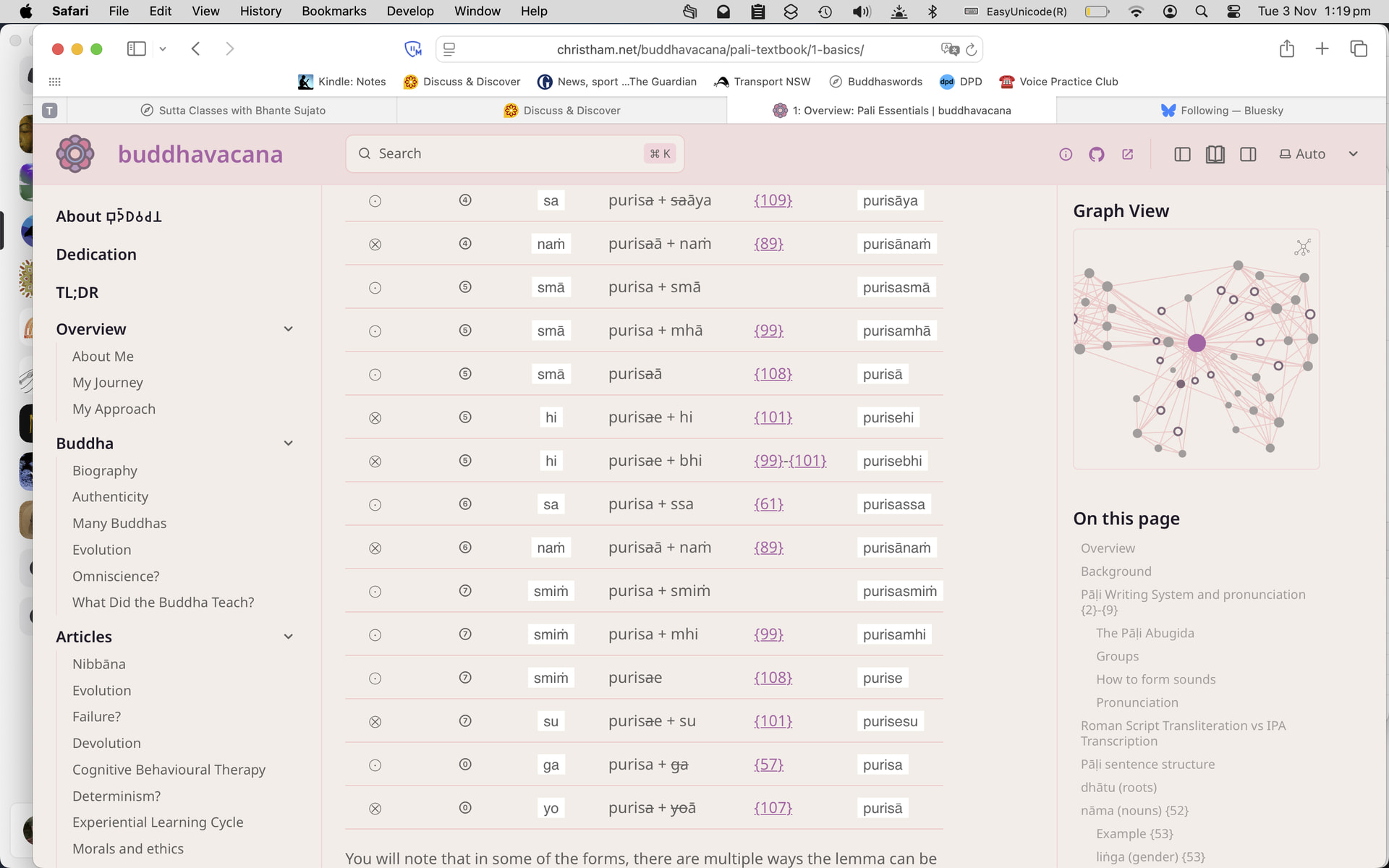
This looks really interesting.

I’m just looking through your pronunciation guide and don’t think this is very clear

e | ten and fate

o | hot and note

I get that you are trying to cover both the short and long sounds, but they have specific rules and these are more often than not long, rather than short unless already part of a long phoneme pair. It’s a strange concept for someone who doesn’t read character syllabaries. Misunderstanding this causes wonky pronunciation such as jot-ika instead of joe-ti-ka for example. Or ten-a; like the sanitary product, rather than tē-na.

Maybe there can be a little asterisk and a note explaining how the sound is shortened to take up the same amount of space when it’s proceeded by a double consonant.

4 Likes

Also, from a readability and design perspective I’d suggest having the pali words as legible as possible. The black on pink isn’t high enough contrast, monospace removes some of the ability for character recognition (the space between characters is a very important aspect of typography), and the decreased size also makes it harder to read. These words are already unfamiliar, no need to make them even harder.

I am also struggling to distinguish the icons in the first column easily due to their light weight (and my old astigmatic eyes) though I really like this approach as a concept.

5 Likes

Thanks Pasanna for your feedback. I am sorry that you are having problems reading the website. Unfortunately, it is optimised for my eyes and not yours. I have issues with high contrast text - they cause double vision, and there is some research that low contrast actually is easier for some people. I also find monospace easier for parsing words with diacritics. Again, these are my personal preferences, based on what works for me.

As a suggestion, the text is open-source and in Markdown. You can view the Markdown files yourself in an viewer of your choice, in a font of your choice. Perhaps that may be a solution for you.

As for pronunciation, as I mentioned “No one knows for sure how Pāḷi words would have been pronounced, and how Pāḷi sentences would have been spoken, particularly with regard to tonality.” Sri Lankan, Burmese and Thai speakers of course all pronounce it slightly differently.

We do know from Gāndhārī manuscripts that Gāndhārī is much more flexible in terms of long vs short, and inflection forms, and there is speculation that Pāḷi originally would have been much closer to Gāndhārī before it was Sanskritised, so I wouldn’t worry too much about precise pronunciation.

I can’t remember where I sourced the example words in the pronunciation guide from, but they are not from me - may have been from the IPA guide but I am not sure. In any case, it is not something I would stress about - as I mentioned in the intro, the book is meant to help people read Pāḷi, not pronounce or speak it.

1 Like

This is astigmatism. People with astigmatism need goldilocks contrast, like you have with your background to body text :heart_eyes: Some browsers will give you contrast ratios in your inspector which you can use to find the optimal color contrast ratios.

If this is your intention then I’d recommend taking out the entire section on pronunciation rather providing information that is without any source. Sri Lankan, Burmese and Thai do pronounce pali differently, but even traditional grammars indicate long and short syllables and how they change with a double consonant proceeding them. This is consistent across these 3 renditions of Pali. The variations in Thai is with the a sound. It’s still the same length but just slightly forward. The variation with the Burmese is with the sounds of the consonants; which you have also defined.

ETA: this thread might be of interest to you as it give examples from Kaccayana and Moggalana

4 Likes

Congrats on this! Putting together a whole textbook from scratch is no joke. I really love that you built it around Kaccāyana instead of trying to shoehorn Sanskrit or Latin structures onto it, and that interlinear translation style looks super handy for diving right in. Can’t wait to check it out!

Thanks @Sanem for your kind words and I really do hope you enjoy the book.

If you are interested in exploring classical Pali grammar further, I am currently in the process of translating Kaccāyana, Buddhappiya’s Padarūpasiddhi and Dhammakitti’s Bālāvatāra. It is on the basis of those translations that I have written my book, and parts of it are inspired by those three works.

Thanks. As I’ve said, the website is optimised for me. It has been designed around the principles articulated in my other website:

Incidentally, Rosely is one of the themes you can apply to suttacentral (courtesy of @Snowbird - I have never tried the theme myself but I appreciate that he took the trouble to make it).

Thanks for this. My textbook does cover all the morphology rules in Kaccāyana, so the introduction on pronunciation is only intended as an introduction.

I would prefer to keep the textbook grounded on Kaccāyana and not conflate rules from other grammars. It is true that the language has evolved across time, and to an extent these grammar books track different versions of the language. This has been an issue with other textbooks that I have been trying to avoid - that they describe a mixture of rules from multiple grammar books without recognising that these rules can sometimes be inconsistent and should not be mixed together. Kaccāyana is not always correct, but he is the most consistent and he limits his grammar to forms attested in the Tipiṭaka, unlike later grammars that incorporate newer features of the language.

In that case, probably better in your introduction just to go with the long e and o and ditch ‘ten’ and ‘hot’. They are more often incorrect than not.

‘prey’ and ‘go’ are probably better examples as they use the same grapheme to represent the phomeme.

3 Likes

Thanks. I appreciate that you may have strong views on this, and my apologies for appearing not to accede to your no doubt well intentioned advice.

My views are somewhat different from yours. As I mentioned, I do not believe the way Pāḷi is pronounced today is necessarily how it may have been pronounced in the past. Therefore what you regard as incorrect may well be correct.

As I mentioned before, the Gāndhārī manuscripts offer a fascinating insight into how the texts may have been pronounced in the past. There is a hypothesis that these manuscripts may not necessarily reflect the language spoken in the region but are transcriptions of how Buddhists texts would have been recited in that time and location, and the manuscripts and the Pāḷi canon may share a common ancestor (the version of the texts transmitted during the missionary activities during Asoka’s period).

The variations we encounter in the manuscripts (the same word spelled differently in the same text by the same scribe) suggest that these variations are not just scribal errors - the scribe was possibly transcribing phonetically, so these manuscripts are capturing how the texts would have actually sounded.

Many Sanskrit sounds “unglide” or reduce to e and o, and Dravidian words also may be pronounced differently from how they are spelled, hence there are natural variations in how words with these sounds are actually pronounced. It is important not to be dogmatic about “rules.” Even in English we sometimes deliberately mispronounce words, or change the stress and length of vowels, as emphasis or for dramatic effect. We should not discount that this may have also been the case in the Buddha’s time (especially if he was trying to satirise Brahmanical thought - there are a few examples of this in the suttas.)

As you probably know, Kaccāyana himself was describing a version of the Tipiṭaka that is different from the one we are familiar with. He describes rules which do not apply to any word in the Tipiṭaka, and sometimes his examples differ from our version. You may also know that Kaccāyana rules are often arbitrary - he often offer alternatives without prescribing when each alternative ought to be used, and he even has a disclaimer that if there is a discrepancy between his rules and the Tipiṭaka, then the Tipiṭaka is correct.

I am trying to maintain an open position. My suggestion is that perhaps you can be more tolerant that others may not share your views about how words should be pronounced. You seem to want to seek a clarity that isn’t there.

Sādhu, thanks so much for this contribution - I look forward to checking it out further. Seems like a great approach to teaching/learning Pāḷi.

Only if you’re interested in feedback: two minor things: (1) on the TLDR; page ‘letting go thoughts’ should probably be ‘letting go of thoughts’ and on the About Me page, the ‘Pāḷi grammar dictionary’ link is broken (page not found).

1 Like

Thanks a lot @Peaceful-D - I have just fixed those errors. If you notice any more, please let me know.

I did ask AI to review the entire site to look for errors and it said it fixed a lot, but obviously it is not perfect!

I think I also noticed another error the other day but now I can’t remember where it is. I am currently working on a translation of Nagarjuna so that is taking up a lot of my time at the moment.

1 Like

For those of you interested in Pali pronunciation, I have updated Appendix B of my textbook to feature a pronunciation guide based on the International Phonetic Alphabet, developed based on research by the World Tipitaka Project: