
In another essay Ajahn @Brahmali  agrees that the cessation sequence of Dependent Arising is about necessary conditions (of the preceding factors for the following). This is good! I agree. However, Ajahn argues that the origination sequence is about sufficient conditions, for each and every link:
Since my writing above didn’t adequately explain why logically this does not work, I want to try one more time. 
So, I’m a monk living in a monastery, where I am assigned a hut to live in. Suppose I argue as follows:
- If I’m not in the monastery, I’m not in my hut. (Premise)
- Therefore, if I’m in the monastery, I’m in my hut. (Conclusion)
The conclusion says that whenever I’m in the monastery, I’m always in my hut. Me being in the monastery is sufficient for me to be in my hut. That’s wrong, of course. I could also be in the Dharma hall, or in many other places in the monastery.
But what’s logically wrong here doesn’t have anything to do with the layout of the monastery. It’s the entire underlying reasoning that is flawed. Even if theoretically the conclusion by itself were true (if my hut would encompass the entire monastery, so I couldn’t be elsewhere in the monastery), the argument would still be fallacious.
To illustrate this further, consider:
- If Pete is not hungry, then Pete doesn’t eat.
- Therefore, if Pete is hungry, Pete eats.
The conclusion means Pete always eats when he’s hungry. Hunger would be sufficient for Pete to eat. We don’t know Pete personally, so it may well be the case! But we cannot logically conclude this from the premise that he doesn’t eat when he’s not hungry. Perhaps sometimes Pete is hungry but still doesn’t eat. Hence the argument is fallacious.
In general, it’s wrong to argue:
- If not Q, then not P.
- Therefore, if Q, then P.
This is a formal fallacy, which means the reasoning is invalid regardless of what we substitute for P and Q. Monasteries and huts, hunger and eating, birth and death, feeling and craving: it doesn’t matter.
However, it is valid to argue as follows, with P and Q swapped in the conclusion:
- If not Q, then not P.
- Therefore, if P, then Q. (Which means the same as: P only if Q.)
The inference also works the other way round, going from the conclusion to the premise. The statements “if not Q, then not P” and “if P, then Q” are logically equivalent. The logical inference between the two is called contraposition.
For example, this would be a valid argument:
- If I’m not in the monastery, I’m not in my hut.
- Therefore, if I’m in my hut, I’m in the monastery.
In other words: when I’m outside of the monastery, then I am always outside of my hut as well. And whenever I’m in my hut, I’m always in the monastery. So I’m in my hut only if I’m in the monastery. For me to be in my hut, it is necessary that I’m in the monastery. (But it is not sufficient, since I could also be in the Dharma hall again.)
Another valid argument:
- If Pete is not hungry, then Pete doesn’t eat.
- Therefore, if Pete eats, Pete is hungry.
In other words: Pete will eat only when he is hungry. For Pete to be eating, it’s necessary that he’s hungry. (But it is not necessarily sufficient.)
To illustrate how I think the Buddha used this logic, let’s consider his argument on feeling and craving in the Mahānidāna Sutta. I use Venerable Sujato’s old translation that uses ‘condition’ for paccaya to not bias the reasoning from the outset. But I will show why, based on logic, ‘necessary condition’ (or ‘requirement’) is a valid reading of the term, while ‘sufficient condition’ is not.
“‘Feeling is a condition for craving’—that’s what I said. And this is a way to understand how this is so. Suppose there were totally and utterly no feeling for anyone anywhere. […] When there’s no feeling at all, with the cessation of feeling, would craving still be found?”
“No, sir.”
“That’s why this is the [or ‘a’] cause, source, origin, and reason [or ‘condition’, paccaya] of craving, namely feeling.” (DN 15)
In short, the Buddha argues:
- If there is no feeling, there will be no craving.
- Therefore, feeling is a condition for craving.
The conclusion “feeling is a condition for craving” (vedanāpaccayā taṇhā) is the standard phrase found in the origination sequence, and the Buddha uses it as such just before the above passage. By analogy with the link between birth and suffering, it should be interpreted as “feeling is a condition for craving to arise”. (Or, what’s grammatically more accurate, to imply the verb ‘to be’, hence I translate “Dependent on feeling, there is craving.”) This conclusion by the Buddha is analogous to vedanā sati taṇhā hoti, as seen for example in SN12.10. The standard translation that omits “only” would phrase this as something like “if there is feeling, there will be craving”, which means feeling always leads to craving. It is accordingly suggested that paccaya here indicates a sufficient condition. (It could be taken to be a necessary condition at the same time, but we can put this aside, since it is not where the problem lies.)
With these assumptions, the Buddha would effectively be arguing:
- If there is no feeling, there will be no craving.
- Therefore, if there is feeling, there will be craving.
- (I.e. feelings are a sufficient condition for craving.)
The problem is, this has the fallacious form we saw earlier (with Q = “feeling” and P = “craving”):
- If not Q, then not P.
- Therefore, if Q, then P.
If the Buddha is instead using the valid principle of contraposition, he is actually arguing:
- If there is no feeling, there will be no craving.
- Therefore, if there is craving, there will be feeling.
In other words: whenever there is craving, there will always be feeling. Only if there is feeling, can there be craving. Feeling is a necessary condition for craving.
This is the valid conclusion to draw from the premise.
Another way to think about all this is as follows. The statement “if not Q, then not P” implies all of P must be included in all of Q. It’s just like, “if I’m not in the monastery, I’m not in my hut” means that my hut has to be in the monastery. So, too, when the Buddha says “if there is no feeling, there will be no craving”, he implies all instances of craving are “included in” times when there are feelings. Whenever there is craving, there must always be feeling too. That is to say, feelings are a necessary condition for craving.
See also these diagrams:
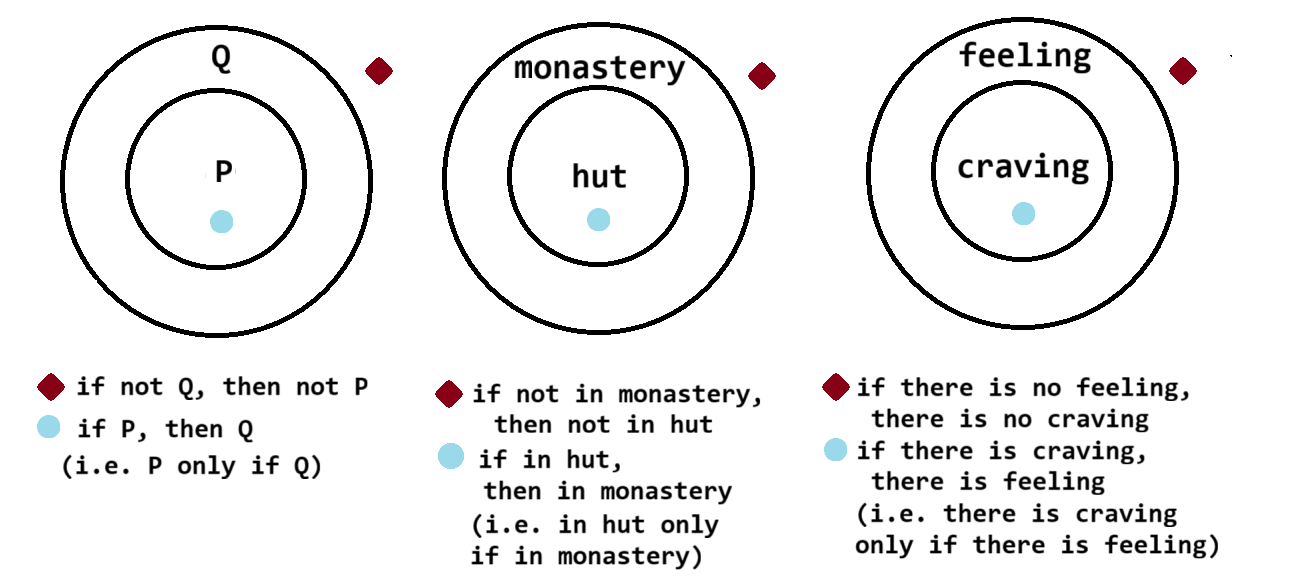
Notice that there is room left for feelings free from craving. This doesn’t automatically mean that feelings free from craving have to exist, however. But logically speaking, from the premise we cannot conclude either way. So the option for feelings free from craving has to remain open.
So what does all this mean for paccaya? From “if not Q, then not P” we can only logically derive that Q is a necessary condition for P. We can not derive that it is a sufficient condition for it. (So we also cannot derive that it is both.) So unless the Buddha’s logic is invalid, by vedanāpaccayā taṇhā he just meant that feeling is a necessary condition for craving. To interpret paccaya as a sufficient condition (or both) would be logically unjustified.
To sum up, there are two options:
- Vedanāpaccayā taṇhā means vedanā is a sufficient (and potentially also necessary) condition for taṇhā, in which case the Buddha’s argument is invalid.
- The Buddha’s argument is valid, in which case by vedanāpaccayā taṇhā he meant vedanā is a necessary (and not necessarily sufficient) condition for taṇhā.
The first option could be right, who knows. However, then the Buddha’s logic would be flawed, and in a very elementary way as well. I just don’t believe it was. I think he was being completely consistent.
If that still doesn’t explain things adequately, it must be my shortcoming. My apologies! Maybe someone else knows a better way to explain. Or can show me why I’m wrong.