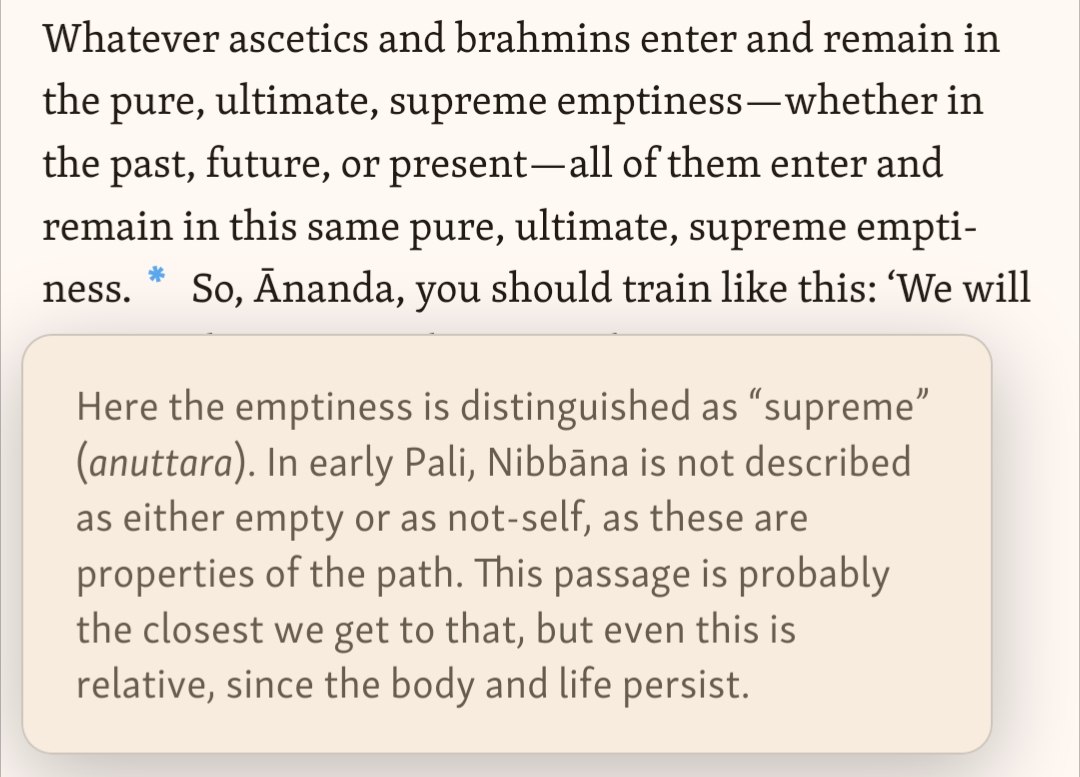
“In early Pali, Nibbāna is not described as either empty or as not-self, as these are properties of the path.”
I wanted to clarify how this aligns with texts such as AN 4.34 (Aggappasāda Sutta) and the general principle of sabbe dhammā anattā.
In AN 4.34, it is stated that among all phenomena—whether conditioned or unconditioned (saṅkhatā vā asaṅkhatā vā)—dispassion (virāga, which is equated with Nibbāna) is considered the foremost. Since Nibbāna is an unconditioned phenomenon (asaṅkhatā dhamma), and the early discourses state sabbe dhammā anattā (all phenomena are not-self), Nibbāna naturally falls under the category of anattā.
Am I misunderstanding Bhikkhu Sujato’s comment, or does it mean that in early Pali texts, Nibbāna is indeed defined as anattā?
This topic has been discussed a number of times on the forum. See for example this essay by Bhante Sujato, with some more links at the bottom of the essay.
Thank you for drawing my attention to this. And thanks also to @sabbamitta for leading us onwards.
(I edited your post with the intention of drawing Bhante Sujato’s attention to your question, and then having rad Sabbamitta’s response I edited it back again. Fyi in case you are wondering about the interference.).
To see something as a self is a wrong view. Only one must remember that to see somethinga as the self is an universal problem, all puthujjana have it. Also this self as a wrong view is always associated with some self-identification. Or at least seeing something as “mine”, since possession implicites someone who owns it.
Nibbana by definition is a result of total desidentification with everything, and total disowning of everything.
There’s a sutta AN10.7 that says cessation of existence is nibbāna.
And that is not in your list as well. I don’t think the list is exhaustive.
I do think that nibbāna since properties can be assigned to it, it is also qualify to be called not self if anything it is just to avoid misunderstanding and subtle believe that Nibbāna is true self.
In AN 10.7 (Sāriputtasutta), Venerable Sāriputta describes a profound state of meditative immersion where, despite not perceiving any of the sensory or formless bases, he remained percipient of a single continuous realization: The cessation of worldly existence (bhava-nirodhaḥ) is Nibbāna.
Here bhava in my translation and understanding is not absolute existence (as in your translation), but a worldly existence, or manifestation.
So this shall be equivalent to Anidassana (non-manifestive) in my list, according to my translation and understanding of course. It seems the list of 35 characteristics of Nibbāna-Dhatu IS exhaustive.
This goes back to the age-old debate that your understanding of Nibbāna as nothingness is Not in my list, and is against my list. But my understanding of Nibbāna-Dhatu, the deathless realm outside of the universe, IS aligned with this list.
AN10.6 also has cessation, nirodho, in the list of characteristics describing nibbana, and it’s not in your list as well.
Also, there’s nibbana with remainder and nibbana without remainder; does your list clearly list which properties apply to which?
The strongest argument against nibbana as something, even as the nibbana element, would be that it’s permanent and the highest happiness. Nibbānaṁ paramaṁ sukhaṁ. Dhp 204 (which, by the way, is also missing from your list).
In SN22.59, the argument for seeing the 5 aggregates as not self is because they are impermanent and subject to suffering. If there’s a thing (ontologically positive) which is permanent and happy, then it deserves to be called a true self.
Any notion of true self, even regarding nibbana as true self, would be blocking the path to nibbana; also, it goes against the teaching of MN1, where only ordinary people imagine nibbana to be mine. nibbānaṁ meti maññati.
The straightforward solution to not having nibbana as permanent happiness, to be not self, is that nibbana is not ontologically positive. It’s the absence of all things. No 5 aggregates, no 6 sense bases. Without mind, there’s also no knowing of nibbana after parinibbana, anyway. No experience of anything after parinibbana. So there’s really no basis to deny complete cessation, as there’s no mind to contact with anything after parinibbana.
@Dan this would be a suitable place to continue discussing our disagreements about nibbana as well.
“To whatever extent there are phenomena conditioned or unconditioned, dispassion is declared the foremost among them - AN 4.34
“Whether or not there is the arising of Tathagatas, this property stands—this steadfastness of the Dhamma, this orderliness of the Dhamma: All phenomena are not-self. - AN 3.136
The Buddha, to argue about the not-self nature of the aggregates, uses the reasoning: the five aggregates are suffering, if something is suffering, how can it be a self? So, it is not-self.
The compass to determine if something is not-self or not, in this case, is to see if it is suffering or not. In this way, to say that nibbana is not-self makes it a strange arrangement, because taking that into account, nibbana would be suffering too.
The self view is a view related to control. At some level, we believe that what is ours is ours so we can do what we want, even if that is nothing. That which we see as my-self is under my-control or can be controlled freely by me, its destiny is in my hand. The aggregates are not-self exactly because, it is suffering, and we can do nothing about it. If Nibbana was self, it would be a thing we would have free reign over it.
My interpretation of nibbana is nibbana is not-greed, not-aversion, not-delusion, hence not-suffering. In this sense, I can’t make sense of any determination of self or not-self to nibbana itself, since I don’t understand nibbana as a thing in existence that can be said in terms of self or not-self.
As I remember, the Buddha says all phenomena is non-self. How could nibbana not be non-self? While nibbana is supposedly empty of all concepts it is still an occurrence which makes it apart of phenomena.
There’s 2 things going on here. If nibbana is ontologically negative or as you say not a thing in existence, therefore your implicit assumption is that properties cannot be assigned to it therefore self or not self doesn’t apply, but you did assigned the property of no suffering to nibbana, no greed, no hate, no delusion. Therefore there’s a contradiction. If nibbāna can have these properties of no suffering, then it can have the property of no self as well.
Anyway, I am in agreement with you that it is ontologically negative and only people who are alive can see nibbāna and therefore describe nibbāna as such and such, but arahants who passed into parinibbāna naturally cannot assign any property to nibbāna as there is no mind to assign property with.
IMO, Nibbana is the wrong thought that didn’t occur, the harsh speech that wasn’t said, the fist that wasn’t raised.
This is known, not unknown.
The thought that did occur, the speech that was said, the hand that was raised… these were conditioned. They occurred because of contact.. unpleasant vedana arose.. sanna arose.. sankhara.. all powered by vinnana. Having come to be, they can mistakenly be taken to arise because of a ‘me’ to whom that contact happened, a ‘me’ that perceived pain and which ‘did’ the act to protect the ‘me/mine’. And we strive to overcome that wrong view via the N8FP.
The thought that didn’t occur, the speech that wasn’t said, the action that wasn’t done.. there neither was, nor is, nor will be any contact that led to that. Its the unconditioned.
Is there a ‘me’ that ‘did’ that… a ‘me’ that can claim “Nibbana is mine!” (MN 1) ?
In a recent conversation here at the Empty Cloud Monastery, Bhikkhu Bodhi commented that the statement “Nibbāna [is] anattā” is not found anywhere in the suttas.
In the Anatta Lakkhana Sutta the Buddha said, “Any kind of consciousness whatever, whether past, future or presently arisen, whether gross or subtle, whether in oneself or external, whether inferior or superior, whether far or near must, with right understanding how it is, be regarded thus: ‘This is not mine, this is not I, this is not my self.’”
What you mentioned are not characteristics of the realm of Nibbana, they are individual purification that may lead to Nibbana. virāgo is a condition to liberation from the world (vimutti), not a characteristics of Nibbana. cessation (nirodho) in AN 10.6 is not cessation of absolute existence, but cessation of rāga, dosa, moha. Same with nibbana with remainder, it manes an arahant while still living in the world with a body… In terms of characteristics of the realm of Nibbana, the list of 35 is pretty much exhaustive.
In AN 10.6 (Samādhisutta), Venerable Ānanda asks the Buddha about a state of concentration where one does not perceive earth, water, fire, air, or any of the formless realms, yet is still percipient. The Buddha confirms such concentration exists:
“Here, Ānanda (ānanda), a bhikkhu (bhikkhu) is thus percipient (evaṃsaññī hoti): ‘This is peaceful (etaṃ santaṃ), this is exquisite (etaṃ paṇītaṃ), namely (yadidaṃ), the stilling of all saṅkhāra / construct formations (sabba saṅkhāra samatho), the relinquishment of all acquisitions / attachments (sabbūpadhipaṭinissaggo), the destruction of craving (taṇha khayo), dispassion / fading of desire (virāgo), cessation (nirodho), Nibbāna (nibbānan)’ti.
I didn’t said that no properties can be assigned to it at all at a point where no description can be done. In my readings nibbana/liberation is commonly talked about negatively, meaning about things that don’t arise. However, in regard to atta and anattā, I don’t think it makes sense talking in terms of either. To put it simply anattā makes sense for me when we talk about things, and since nibbana is not a thing, it doesn’t make sense to say that nibbana is anattā. As well as it doesn’t make sense to argue if nibbana is red or orange.
Sure, I wouldn’t say nibbana is with a self, but to say it is anattā is the same thing as to say that nibbana is colorless, or I don’t know avanna (vanna being the Pali word for color). Like, it doesn’t apply.
Nibbana is empty of suffering; similarly, it is also empty of self.
In terms of things that don’t arise, if suffering can be said not to arise because there’s no mind or body to suffer, similarly, colour can be in the same thing, no form to have colour to arise.
Also, it’s just semantics, indeed, in another way of seeing, properties of things cannot be applied when there’s no thing.
I am not sure if there’s a clear philosophically rigourous way of separating which properties can be applied to nibbana as ontologicall negative as opposed to which properties can.