
Uttarakuru is a mysterious land mentioned in the early Buddhist texts. I think I’ve found where it is, or more to the point, what it is. If you want to follow me there, be warned. The paths are new-hewn and rough, ofttimes barely more than a goat-track. So be prepared to make some leaps!
Its name is no mystery, even if the sense is elusive: it is “North Kuru”, where Kuru is the classical kingdom of the ancient Vedists, located around the modern city of Delhi. It was at Kuru where two branches of the family, themselves both ultimately Kurus, faced off against each other over a scarred battleground, wondering if they could retain some humanity after being driven to such extremes. In Buddhist texts, the king of the Kurus is seen as a mortal man, his power subject to waning, while he is still slave to his own desires (MN 82:27.1).
It’s possible, likely even, that some of the references to a “North Kuru” refer simply to a division of this nation, since we also find reference to a “South Kuru”. This mundane northern Kuru would perhaps be modern Uttarakhand. Or else, per an early source, a country north of the Himalayas, of republican governance (Aitareya Brāhmaṇa 8.14). But that is not what interests us here.
The Uttarakuru of legend is an altogether more intriguing place. It is one of those lands at the edge of the map where wonders abound. It seems often rather more heavenly than earthbound, yet it is most certainly part of the earth.
From the earliest attempts to map the globe, scholars have attempted to nail down its location. Ptolemy knew it as Ottorokora. He spoke of a land, a people, and a town of that name, locating it on the borders of Serica, often identified with China (Geography, 6.16). Pliny knows the land as that of the Attacori, who bordered the Seres (north-west China?), in a sunny land surround by hills in a mild climate like that of the Hyperborei (Natural History 6.20). The geography of these two scholars, despite their erudition, is not very reliable at such distances from Rome. Nonetheless, it does show that Uttarakuru was well known to not just the Indians, but to those who traded with them.
It is the nature of ancient myth that the surface of the text presents a dazzling and ever-shifting series of startling images. The mind tends to bounce off them, seeing them as tiny refractions of reality, or alternatively, mere seemings produced by the dazzle. This show is quite deliberate. It is meant to distract the dilettante or the skeptic, leaving them with the impression that there is nothing to see, only show and surface. A slower and more contemplative gaze, allowing time for the eyes to adjust, often reveals much that once seemed hidden.
among the ruins of ancient Persia
Let us begin in ancient Persia, that graveyard of Western empire, with the people known today as Zoroastrians or Pharsees. They maintain an ancient scripture in Persian, long thought lost, called the Zend Avesta, which has been partially recovered and published. It shares much in common with the Vedic literature, and represents another branch of the old Proto-Indo-European religion.
Chapter two of the Avestan Venidad tells of the good shepherd Yima son of Vivanghat, who was the first mortal, first priest, and first king. He governed a world that became overpopulated and over-abundant. Vowing to expand the worlds, he stepped towards the sun in the south. Pressing the earth with the royal insignia, or crushing it beneath his heel, he asked the Earth expand to accommodate the flocks and herds and men; his world was pastoral, not agricultural. Over many centuries, the cycle kept repeating and the earth opened further south.
In a subsequent mythic cycle, Yima had to defend his people from the snows and colds of a terrible winter, perhaps an echo of the encounter of the Proto-Indo-Euopeans with the Himalayas. Yima builds a sanctuary, an idealized land of abundance where every fortieth year, each couple gives birth to a male and female pair, thus hinting at his Vedic association with twins, as well as with a northern paradise.
A further mythic cycle is found in the nineteenth or Zamyad Yast. There Yima is once again an all-ruler of a idealized realm of peace and abundance. But he began to listen to words of falsehood, and his Glory fled from him in the shape of a bird, entering the forms of three other heroes, signifying the splitting of the one people. This has echoes of Vedic Yama’s fall from immortality, but also the corruption of the line of wheel-turning monarchs, no doubt due to the overweening pride that befell the likes of Mandhātā.
There is no doubt that Yima son of Vivanghat is the same person as Vedic Yama son of Vivasvant. It seems the name has the original senses of “control, bind, couple”. He is, fittingly, strongly associated with kingship, and I propose that the Avestan sense is his original role: the king of the primordial realm. But what has this to do with Uttarakuru?
Saraṇyū the fleet and her shadow
Here the connection runs via his mother, Saraṇyū. Nonetheless, we must be patient, for in her first appearance in Rig Veda 10.17.1–2, as in the Zend Avesta, there is no mention of Uttarakuru (Jamison/Brereton translation):
“Tvaṣṭar is arranging a wedding for his daughter”:
(on hearing) thus, all this world comes together.
The mother of Yama, the wife of great Vivasvant,
while being conveyed around (on her wedding journey), went missing.They hid her away, the immortal, from the mortals.
Having made a female of the same appearance, they gave her to Vivasvant.
And she was carrying the Aśvins (in the womb), as it happened,
and she left behind the two, the paired ones [=Yama and Yamī?]—Saraṇyū.
In the Vedic style, this is designed quite deliberately to be obscure as possible, so that the meaning is only clear to those in the inner circle. Her name is only stated at the end, a conceit we find also in the Buddhist poetry on Uttarakuru; perhaps just a coincidence, but it demonstrates the point of how this is a deliberate rhetorical device. But the obscurity runs much deeper here. It would lead us too far astray to delve into how exactly the legend evolved, but with due respect to the passing of time, we can look for guidance in the later legends. These are many and long, but here is the gist.
Saraṇyū, the wife of Vivasvant, the Sun, after giving birth to the ancestor of all humans Manu, and the twins and first mortals Yama and Yamī, fled her husband, whose scorching heat blackened the skin. She created a copy of herself, Chāyā the Shadow, to fool her family that she was still there, while she sought refuge in the home of her father Tvaṣṭar, the “fashioner”. But he ultimately said she must fulfill her wifely duties. It is said that, taking the form of a mare, she grazed in the pleasant fields of Uttarakuru. On discovering the ruse, her husband sought her out. He followed her to Tvaṣṭar’s house, where they struck a deal. A portion of the sun’s energy would be syphoned off, reducing his overbearing heat for his wife, while at the same time providing Tvaṣṭar with abundant solar energy for his military-industrial applications. Tvaṣṭar was responsible for smelting and fashioning all things, and as such had a close connection with the underworld of Kuvera, from whose domain he sourced his materials. It is not stated as such, so far as I know, but I cannot help but suspect that he helped his daughter to transform into a mare. Regardless, Vivasvant pursued his wife as far as Uttarakuru, whereafter they made up. She gave birth to another pair of twins, the Aśvins, charioteers of the Sun.
There are so many interesting details in this mytheme, but let me mention just a few. First, this is an indubitably ancient mythic cycle, old even at the time of the Vedas, where we find Yama and Yamī quoting ancient scripture to each other. We’ve already seen that it is shared with the Avesta and hence must be Indo-Iranian at least. Some details cement this association: Avestan Yima heads south towards the sun, while Saraṇyū heads north to escape the sun. Both of these suggest a memory of a land to the far north where the sun is less intense than in India.
But some details are older, Proto-Indo-European. The Aśvins, the divine twins associated with horses, are one of the most ancient PIE mythemes, known as the Aspinas of the Avesta, the Asvieniai of the Lithuanians, and the Dioscuri of the Greeks. Indeed, Saraṇyū’s story bears more than a little in common with Helen of Troy, and they might both contain echoes of the same old mytheme, the abducted woman. This, in fact, may predate even the PIE culture and be the oldest mytheme of all humanity. But I digress.
Perhaps we could be so bold as to see Saraṇyū’s journey as a retracing of the road from India to Uttarakuru. She first went to the house of her father, known for his metallurgy, thus representing the technical developments made on the long journey. Then she proceeds past him, to the fathers of the fathers perhaps, to give birth to twins in her ancient family home, in accordance with old Indian custom; recall how Māyā traveled home to give birth to the Buddha, after which she too disappeared like a mirage. And this family home in the cool north is associated with horses, since it was the PIE people who first tamed (yam) the horse and paired (also yam or yoj) them to a chariot.
not to speak of Yama & Yamī
Yama and Yamī are the archetypal twins. But their role in this is, well, hard to even think of, as Rig Veda 10.12.6 tells us.
Difficult to contemplate is the name of the immortal (male) in the case
“that (the female) will have the same ‘marks’ [=family characteristics] (though) dissimilar form [=gender].”
Whoever will contemplate Yama’s (name that is) good to contemplate—
protect him unremittingly, o lofty Agni.
Even the translator’s editorializing brackets show how hidden the meaning is. But this is nothing more than the Streisand effect—the more they try to hide it, the more we’re interested. The verse is quoting from an earlier passage, and it says the immortal name, unstated, is hard to think of, but we can call him Yama, which is presumably his mortal name, though again, this is left unstated. Since in Vedism what is immortal is what is real, why is his true name hard to think of? And why am I drawing this out, dancing around the unavoidable topic? Here’s Yamī making a proposal to her brother in Rig Veda 10.10.
[Yamī:] I would turn my partner right here to partnership—
even though he has gone across many (realms), across the flood.
A (ritual) adept should provide a grandson for his father,
envisioning his furtherance on the earth.
Yama wants none of this, and in his rejection we see the words that are quoted above:
[Yama:] Your partner doesn’t want that partnership, in that
she [=sexual partner] will have the same “marks” [=family characteristics] (though) dissimilar form [=gender].
The sons of the great one, the heroes of the Lord,
the upholders of heaven, look around widely.
He rejects the proposal of incest with his sister, on natural grounds—they are too close—and legal ones—the gods are watching. It seems the idea of morality through surveillance is not a new one. Both she and he cite ancient precedent, but she becomes more direct:
Desire for Yama has come to me, Yamī,
to lie together in the same womb [/place].
Like a wife to her husband I would yield my body.
We would “let ’er rip” like two chariot wheels.Night and day she would do service to him.
She could for an instant trip up the eye of the sun.
The couple has the same (kin-)ties as Heaven and Earth.
Yamī could bear the unbrotherly (act) of Yama.
The whole poem is a literary masterpiece, but I’ll try to keep it brief. It’s a lively dialogue which is constructed to sound like genuine banter. “You jerk, you really are a jerk, Yama!”, says Yamī at one point. It’s one of the genre of myth where a younger generation tries to rationalize the “morality” of the beliefs that have passed down to them. That is to say, as cited in the poem itself, the motif of twins or siblings having sex was already ancient. Yamī notes that Heaven and earth also coupled, and everyone knows they are siblings. But Yama is skeptical, “Who knows about this first day? Who has seen it; who will proclaim it here?” All of this is exactly how religious dialogue about ethical issues proceeds to this day.
The poem ends inconclusively, not stating that they ended up “letting ’er rip” or not. But as we have seen, the Vedic poets were reluctant to even think about this episode, so their meaning must be discerned in their silence, as is so often the case with family secrets. But at Rig Veda 10.14.4, we are told this of Yama:
For the sake of the gods he chose death
and for the sake of offspring he did not choose immortality.
It seems, then, that Yama and Yamī did indeed consummate their sexual relationship, resulting in offspring, and making them mortal. In later legend, Yama is often reinstated as a god, but he and Yamī are also remembered as the first mortals.
We have seen that their mother, Saraṇyū, gave birth to twins in Uttarakuru, and it is no great leap to imagine that the multiplying sets of twins are different expressions of the same idea. And as we have also seen, Yama was very early on associated with a great realm of abundance in the north, similar to Uttarakuru.
The connection between Uttarakuru and twins is widespread, being found in Jain mythology (Triṣaṣṭi-śalākā-puruṣa-caritra 5.1.3) as also among the Vedists (Padma Purāṇa 3.4.8, Brahmāṇḍa Purāṇa 2.15.77). But why?
The twin motif is associated with the origins of peoples, as entire races are born of one blood. For example the Sakyans stemmed from the incest of brother and sister (DN 3:1.15.11). Saraṇyū is also the mother of Vaivasvata Manu, father of all men, or more strictly, men who follow the Vedas. Again the mytheme splits in dazzling reflections, as she has two sets of children, one herself and one by her Shadow. Still, there is little doubt that with Yama as the first mortal and Manu as the progenitor of humanity, we are speaking of the origins of the Vedic people. And, since the mytheme is much older than the Vedas, perhaps the origins of the PIE people as a whole.
But the very nature of the twin suggests a multiplying and a mirroring, and so this mytheme abounds in dyads, such as the “twin” carts that bring soma to the ritual; or the two destinies of the dead, the gods or the forefathers; the two hounds of hell, each with two pairs of eyes; the twinned horses of the chariot; and so on.
Incest between divine twins emphasizes the merging of the self in the act of sex, the loss of individual identity binding oneself to death through the creation of offspring. The inverse is the splitting of the self into two, the living body and the dead shade, which is desired as promising immortality and feared as the reminder of mortality.
These dual anxieties cling to the cremation fire, which is urged to not harm the dead, then immediately to cook them and send them to the ancestors (RV 10.16.1), “who have Yama as king” (RV 10.16.9). In this way Yama is bound to Agni, the original messenger of the gods. This is of more than incidental significance for the history of Vedic, and hence Buddhist, thought, for in the call for a dying man to “unite with Yama in the highest heaven” (RV 10.14.8) we discern a precedent to the Upaniṣadic idea of the temporary separation of the self from divinity, or its forgetting of its true nature as divinity, and the eternal return.
footsteps along the paths to the dead
There is another connection between Avestan and Vedic sources worth noting. We have seen that Yima’s assertion of dominion involved a powerful footstep on the earth. Yama’s crushing footstep features also in various later Brahmanical accounts when Saraṇyū has already fled, leaving the shadow Chāyā as false wife and mother. Though the ruse is initially successful, she cannot help but betray her nature by showing favoritism to her own children over Saraṇyū’s children including Yama. Yama is angered, and makes to step upon the shadow Chāyā, but refrains. Nonetheless, Chāyā curses him that his foot will fall off, a curse so powerful that even his father Vivasvant can only mitigate it, so that part of Yama’s foot will be consumed by worms. It is this that ultimately reveals Chāyā’s false nature to Vivasvant.
In both cases, Yama’s footstep is an assertion of his power, to expand the world of men through emigration and conquest, or to punish his mother, the shadow that lies on the earth. His curse, then, is his failure to assert his royal dominion.
This, too, is associated with geography. For Vivasvant, whose excessive heat has driven away Saraṇyū, has his power reduced by her father Tvaṣṭar. Only then can the diminished sun return, perhaps going beyond the father to the land of the father’s father, to the temperate climes of the north in the form of a stallion and reunite with his real wife in the form of a mare. The motif suggests that the expansion of Aryan power reached its limits in the far south, with the corruption of Yama’s foot, where only a simulacrum of its original power persisted in corrupted form. The divine couple must return to their blessed homeland in a renewal of the cycle, the inexpressibly potent mating of stallion with mare.
We are finally approaching the more familiar role of Yama in Buddhist texts as King of Death, or more technically, guardian of the paths or rivers that lead one from one life to another (SN 1.33:10.3, MN 130:3.1, Dhp 235). As the first person to die, he discovered the paths to the lands of the dead that he now guards with his pair of four-eyed hounds (RV 10.14), who are named at Snp 3.10:27.2 as the hounds of hell. According to the Avesta, Yama is king of the realm of the forefathers in the most literal sense: he was the actual king of the ancient realm from which the Vedic peoples descended.
Uttarakuru reclaimed by the Buddha
Most of this mythology, being “hard to think of”, is submerged in the Buddhist sources. Yet we can perhaps see subtle hints, if we squint in a certain way.
Take the episode when the Buddha went to Uttarakuru for alms (Kd 1:19.2.1). It occurred at a time, shortly after the Buddha’s awakening, when the Buddha was staying as guest of the fire-worshiping brahmin ascetics, the three Kassapa brothers. He faces many challenges, often associated with fire, and overcomes them all with his psychic mastery. Still, for all his spiritual mastery, he had to eat, even when his jealous host didn’t want him at the feast. So he went north.
The Buddha went to Uttarakuru, collected almsfood there, ate it at the Anotatta lake, and stayed there for the day’s meditation.
Now, if it were me, and I wanted to avoid embarrassing my host, I might simply go for alms to the next village. But then, I’m no Buddha.
Notice the name of the lake, as names in such ancient texts are almost always of some significance. Anotatta is a lake of legend, the “unheated”. Whereas the ascetics worshiped fire as the divine principle Agni, the sun-god come to earth in the lightning, the Buddha saw fire as scorching and painful. It was shortly after when he gave the famous Fire Sermon, opening with, “All is burning.” For him, the goal was the state of coolness (sītibhūta), Nibbana, the going out of the flame.
Uttarakuru is thereby associated with coolness. This of course makes sense, since north of India lie the Himalayas, and beyond them the temperate climes of Central Asia. By implication, too, it is associated with abundance. Finally, it’s in a context of Vedic one-upmanship. The Buddha shows that he is a truer heir to the Aryan traditions by returning to the very source of those traditions and gaining sustenance there, when the contemporary Brahmanical tradition had fallen into pettiness. Just as, we might think, Saraṇyū also returned to Uttarakuru to revitalize the Vedic tradition.
The most substantial account of Uttarakuru in Pali is found in DN 32, the Āṭānāṭiyasutta. There, the Buddha is attended by hosts of gods, and one of them, Great King Vessavaṇa, recites the Āṭānāṭiya protection verses to ensure the yakkhas remain placated. One section of these verses, indeed the section that gives them its name, concerns the northern realm of Uttarakuru.
We learn much of the land and its people. They are “unselfish, without possessions” (DN 32:7.4; also at AN 9.21). Like the proto-humans of DN 27, they do not sow or plough, but live by the natural abundance of the land, eating only such food as grew that day. This is an idealized depiction, but the insistence that they, unlike the Indians, are not agriculturalists is worth remembering. But eating too much, they became differentiated in appearance, and sex characteristics appeared on them. For Buddhism, sex is not innate or necessary, but contingent and conditional. Having become separated, they burned with lust for each other and eventually had sex. The Pali word for sex, methuna, literally means to “reciprocate”, an apt term for the act when the newly separated long for return. It reminds us of the twin motif, which through sex returns to the state before separation.
The ancient brahmins as imagined in Snp 2.7 also kept no possessions but lived a life of purity and abstinence. This was a state of nature, of balance and moderation by comparison with which the (then) modern world was hopelessly decadent and corrupt.
The next verses of the Āṭānāṭiyasutta introduce us to a series of paradoxes.
Having made a cow uncloven,
they follow from quarter to quarter.
Having made livestock uncloven,
they follow from quarter to quarter.
Now, cows are most definitely cloven. The “livestock” (pasu) is any domesticated (“leashed”) animal, which normally includes cattle, sheep, and goats, all victims of the sacrifice, and all cloven.
Which animal is uncloven or “one-hooved” is no mystery: it is the horse (Jātaka 544:98.2, Bhāgavata Purāṇa, 3.10.21–22). How a cow is made a horse is not stated, but it seems these lines are meant as a deliberate paradox, of the sort familiar to Vedic poetry but mostly absent in Buddhism. It seems that Saraṇyū was not the only case when Uttarakuru witnesses a mysterious transformation into a horse. Remember, the horse was tamed there, so the image of a person riding a horse, becoming one being, is deeply inscribed in PIE consciousness.
Once the paradox is resolved and the “cow” recognized as a horse, we see in these lines an allusion to the horse sacrifice. The centerpiece of royal Vedic ritual, the horse sacrifice involves anointing a horse that wanders for a year in any direction it chooses. The king and his retinue follows the horse, and every land it crosses is declared to be his. Thus these verses allude to the establishment of a royal dominion widely across the land. In the Buddhist re-framing, the wheel-turning monarch follows the wheel from quarter to quarter, where the “wheel” is both the sun and the chariot, whose deities are of course Saraṇyū’s children, the Aśvins (DN 26:6.3).
The next series of lines also seem paradoxical, but they refer to further traveling to the quarters, this time apparently in palanquins of women, men, girls, or boys. The burden seems to be that dominion is established in all quarters by the king, relying on the support of all his subjects.
Having mounted vehicles,
they follow to every quarter,
the emissaries of that king.
“That king” is as yet unnamed. This deliberate obscurity is the style of these verses throughout. In the Āṭānāṭiyasutta as a whole, we are now discussing the fourth king in the fourth direction, and in each case the name has been withheld, heightening the aura of mystery. Indeed the name of the Sutta is derived from this, again showing that the longest and most detailed account is withheld. We’ve already seen this stylistic marker of Vedic texts, where Saraṇyū’s name is withheld to the end of her verses, or Yama’s name is hard to think of. This is in marked contrast with the opening verses, which in good Buddhist style are direct and immediately name their subject “Vipassī”. In speaking of the four great kings, the poet follows the Vedic dictum that “the gods love hidden things”.
We do, however, learn the divine king’s name a few verses down. It is Kuvera, also known as Vessavaṇa (DN 32:7.43, Snp 2.14:6.1), which means “Son of the Renowned” from his father Viśrava, originally an epithet of Agni (Rig Veda 3.11.6, 5.25.5).
These two names appear together elsewhere in contemporary literature, where they form quite a contrast with the Buddhist source. In Atharvaveda 8.10.28, he is associated with “otherkin” (itarajana) and with concealment (tirodha), foreshadowing his later connection with the “hidden ones” (guhyaka). In Śatapatha Brāhmaṇa 13.4.3.10, his people are said to be demons and wicked thieves.
Although a god of wealth (dhanada), the name Kuvera is explained by lexicographers as “deformed”, and he is often depicted as a dwarf or gnome. Probably he was originally a god of the underworld, blessed with the earth’s riches, yet deformed by its great pressure, perhaps stooping like a miner, his posture reminiscent of the lame god known in the west as Vulcan or Hephaestus, and further suggesting a connection, as already noted, with Tvaṣṭar, father of Saraṇyū and grandfather of Yama and Yamī, and perhaps with Yama himself.
the end of our journey
We are now in a position to draw these threads together and say why it is called Uttarakuru. The Kuru kingdom was the time when the Vedic peoples, unifying their fragmented and warring clans, established a powerful empire in the land of India. It became the icon of a fantasized primordial Vedic culture, and has remained so even for Hindus to this day. Thus “Kuru in the north” is the projection of this empire into the mythic past. Thus, while the elements of the mytheme are very ancient, the name of Uttarakuru is relatively modern, stemming only from a time when even the glory of Vedic Kuru was a memory.
Uttarakuru was the place where the ancestors of the Vedic peoples lived all together: one race descended from royal incestuous twins; one realm unified under the just king Yama and empowered through the taming of the horse and invention of the chariot; a pastoral realm so abundant and fruitful that no grain need be grown; a place of sylvan beatific happiness beyond the northern mountains, where the sun is warm and bright.
I propose it is none other than the ancestral Proto-Indo-European homeland, today largely agreed to be in the mild grasslands of the Pontic-Caspian steppe, where horses were tamed and chariots invented. When they journeyed to the south, the sun grew over-fierce, darkening the skin. And the knowledge of the land of the fathers became hard to speak of, its reality attested in the margins and hollows between words. Yet the people who left always felt a strange longing, an echo of a reflection of a shadow of the pleasant land they once called home.
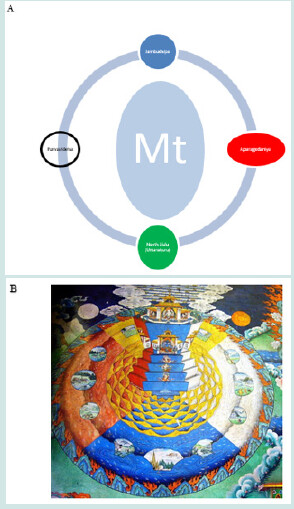

 . It is a refreshing and (IMO) necessary study to more fully appreciate how remarkable and stark was the Buddha’s departure from the Vedic mytheme. No wonder he was an outright heretic.
 at this time?
