
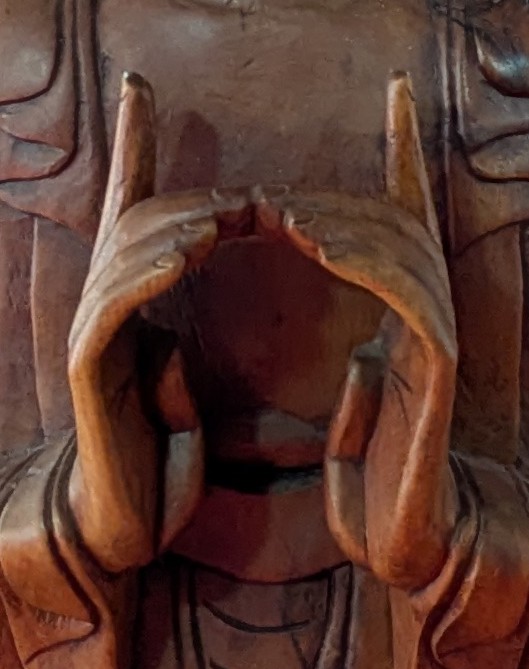
This is from a sitting buddha in a local Dojo, it seems to be a carving from Bali, just wondering what the Mudra means?
4 Likes
Bali is kind of famous for its woodcarving export industry. Buddha statues from there rarely conform to traditional iconography. Basically the artisans will make things up that look interesting. I think that’s what is happening here. I’m not aware of this as a standard hand position. Even if the hands are treated individually, I don’ t think it has any meaning.
9 Likes
Hmm, it’s not one of the popular mudra.
You can actually find out more if you include who is making the mudra? Is there any other iconography (crown, robe, vehicle etc)?
Well even with that there is a possibility that you won’t find the answer, there are many such obscure mudra, they were recorded in a certain ancient books, only used rarely, only in certain sects etc.
2 Likes
reminds me of this…

EDIT:
Which is not so silly actually. When I’m teaching kids the meaning of “Sādhu!” I tell them it means “Excellent”. So maybe we could name this the “Sādhu mudra”.
13 Likes
I think it’s a mudra from esoteric Buddhism or Tantra. The mudra looks similar to the Dharme Mudra or Tarjani Mudra, which is an mudra from Vajrayana.
other Mudras:
https:// buddhismnow .com/2014/06/18/scroll-of-mudras/
[59 Powerful Yoga Mudras Explained with Benefits - Fitsri Yoga | Yoga Alliance Certified Online Yoga School](https:// www.fitsri .com/yoga-mudras)
https:// www.bibhudevmisra .com/2017/11/yoga-mudras-in-orthodox-christian-art.html
https:// asivanayoga .com/blogs/hand-mudras/complete-list-of-yoga-mudras
1 Like
I think it is Manidhara mudra. Gesture of holding the jewel. The hands are arched and hold a wishing jewel, which can not be seen because of its transparency. This is a mudra of Avalokiteshvara, and is often confused with the similar gesture of greeting.
1 Like
Thank you all for clearing it up & the warmth & humour.
The statue sits in a Karate Dojo and it was great to tell the Sensei your findings. It’s a traditional Okinawan school, so it seems fitting as protection of Knowledge.