Hi @Hasantha
Yes, the new Bilara now supports adding tags to suttas. Please visit https://bilara.suttacentral.net and log in, and I will activate your account.
Hi @Hasantha
Yes, the new Bilara now supports adding tags to suttas. Please visit https://bilara.suttacentral.net and log in, and I will activate your account.
I plan to amend my original plan based on the various suggestions as a baseline skeleton of tags, but this will be an iterative process so it is likely the “other” tag will eventually expand from whatever original plan I have. You could tag the entire suttas with “dukka” or tag every word as a unique tag; but neither of those extremes would be very useful. I dont know exactly where the ‘Middle Path’ is in this exercise but hope to come to some reasonable approach without too many tags, whatever that means.
No preference, given I plan to cover at least the 4 if not 5, but Bhante Sujato suggested Diga Nikaya.
Yes, I would tag that as 4NT as the main tag (I plan to use the first tag as the prime one, but include other tags that are relevant as subsequent ones, but will need to check whether Bilara can deal with tags in an ordinal way…I assume yes???)
Yes…that is the plan!
Wonderful thanks, much appreciated! 
I would assume it can’t. For sure you will need to check.
The DN is not super dense with topics compared to other nikayas, since it includes so much narrative content. Which maybe is a good thing, I don’t know. Except for the last two suttas which are basically nothing but topics.
One disadvantage of coming up with themes (tags? topics?) as you go is that you will then have to somehow go back and make sure there weren’t instances in previous texts you have already done.
In indexing there is the concept something like… you can always cut it off but you can never cut it on. Meaning that it’s far easier to remove things from a project like this then add them in, since it basically means starting over (or at least doing a really good search).
Since I wasn’t creating a data set, I wasn’t terribly worried about missing out on a specific instance of a topic in previously indexed texts. And if there isn’t perfect uniformity in terms it’s not a big deal. But if you have the idea that people will be able to use your data to come to conclusions about the texts… well, their conclusions will only be as good as the data. This is one of the reasons that I haven’t given permission for people to use the CIPS data for other projects.
This is incredible. Thank you so much!
Thanks for the feedback and for @Hongda granting me access and onboarding me!
Will discuss with @sujato tonight but let me know if any other last minute suggestions as I want to start this Long Weekend in New South Wales (Labour Day Public Holiday).
Updated protocol below with expansion to 15 “Foundational themes” that I think captures the feedback with less in the ‘other category’. I realised that I didn’t have Ignorance, Greed Hatred or Delusion listed so glad I had time to review. Was struggling to work out where to put all the various lists and so decided to have broad categories of barriers and facilitators to progress as ‘catch-all’ (I hope) broad categories for some of the items Adrian suggested.
Thematic analysis of EBT protocol (2nd Oct 2026)
Aim: To perform a detailed thematic analysis of the entire Early Buddhist Texts (EBT) Sutta Pitaka to enable readers to develop an understanding of the core teachings found throughout the texts.
Early Buddhist Texts (EBT): Pali Dīgha Nikāya; Majjhima Nikāya; Saṃyutta Nikāya; and Aṅguttara Nikāya using Bhante Sujato’s English translation on Sutta Central. The Khuddaka Nikāya and other texts may be completed after the first 4 Nikāyas.
Datasource: Bilara software using Bhante Sujato’s English translations of the EBT from: SuttaCentral
The unit of analysis will be the existing ‘segments’ in Sutta Central (logical chunks of text, such as verses or sentences, already built into the software).
Themes: these are the 15 pre-determined Foundational Themes. There can be more than one theme per segment. Additional themes may need to be added later by disaggregating the “other” theme. Themes will be recorded as comma delineated free text with the main theme listed first.
Foundation Themes and codes:
4nt= Four Noble Truths (use nib, 8fp if those are the main focus)
8fp= 8-fold Noble Path (including precepts; right efforts; gradual training)
k= Karma
r= Rebirth
do= Dependent Origination (any references, whether the number is 12 or not)
5k= 5 Khandas (Incl. sense-bases)
med= Meditation (mindfulness; bhavana; sati; samadhi; jhanas)
nib= Enlightenment (Nibbana; Noble Ones, incl stages and qualities)
bra=Brahmaviharas (mettā; karuņā; muditā; upekkhā)
hin= Hinderances to progress (avijja; 3-poisons; 5-hindrances; 8-winds)
sup= Supports to progress (4 right efforts; 4-iddhipada; 5-powers; 7-bojjhańgā)
rit= Rituals (chanting; statues; incense; flowers; lamps)
gen= Gender and sex (incl ‘it is not by birth’; LGBTQI; paņḏaka)
str= Structural text (greetings; setting; context)
oth= Other (all remaining text not allocatable to above themes)
Footnotes:
Reviewers: I will read each segment and allocated to the themes listed with the plan to disaggregate the “other” theme into specific themes if they arise repeatedly. Given I have already read the entire DN, MN, SN and AN (Sutta Central or other translations), we plan to conduct this thematic analysis deductively rather than inductively. Given this will be open for review any segment allocation can be questioned by any reader and reviewed and potentially reallocated. Our aim would be that other reviewers would replicate this work to add validity to what will always be subjective allocations.
Repetition: Although much of the EBT is repeated, often verbatim, we will still allocate themes to each segment given the repeated verses can be slightly different and the fact that the teaching is repeated suggests added importance warranting duplicate tags.
This list made me think of Leigh Brasington’s gradual training coding system… Which made me think, you don’t have a tag for gradual training (GT)! Leigh’s already done the work.
Thanks Venerable. Adrian mentioned this in his input:
When I thought about this I felt it would fit in the 8-fold path broad category. Does that sound reasonable or do you think it should be its own category?
Having its own unique tag would only sharpen the ability to find specific mentions of gradual training as the primary focus of a segment of the suttas, whereas having it in the broad 8fp category (as I have done) would still enable us to determine the footprint of “gradual training” mentions across the EBT just not delineating where it is the specific focus of the text.
In short: I tried my best to limit the number of categories so this body of work is manageable but authentic lol
Update after a quarter DN tagged:
DN1 to DN10 has helped me hone in on the tags and definitions, adding another 10. Would appreciate any advice as below:
EBT Themes 20261006.pdf (113.3 KB)
In case that upload doesnt work a summary of main changes/additions:
eth; Ethics and precepts=Good/bad conduct generally (not specifically for monastics) and precepts
mon; Monastic code=Good/bad conduct specifically for monastics, incl monastic code
sci; Science=Physics, the cosmos (incl questions not answered)
lif; Life form=Realms of existence, incl immaterial, fine material, sensual and lower realms
ren; Renunciation=Going forth, incl qualities; and renunciate discussions
ani; Anicca=Three marks of existence: impermanence; suffering; and no soul (any one or all)
xxx; Issues to resolve=Need to review these tags (I see untranslated segments…?duplicates)
mir; Miraculous powers=Miracles, psychic powers
awa; Awakened=Examples of someone becoming awakened (any stage)
deb; Debates=Debates and discussions with disagreements (not pure teaching)
Debates makes it much easier to code lots of text to do with back and forth debates and discussions with disagreements, which I thought would be interesting to note (and its much of early DN!). I am trying to minimise the str and oth tags and this does that well (hardly any of those tags so far).
@AdrianMagno @Pasanna @sujato and others who have comments, appreciate any advice before I proceed with the remaining 280k segments (minus the 10 suttas to date)
@HongDa would also appreciate if you can confirm that all is well and tags are attached correctly (sometimes the system adds spaces between commas and sometimes it doesnt, not sure if I should be using spaces or it doesnt matter???)
I think I am going to get in trouble with work as I am absolutely loving this so far
Is there a reason you aren’t using human readable words as the tags?
Thanks, there were specific instructions from HongDa re the tag (lowercase alphanumeric no diacriticals or punctuation or spaces etc) and the expansion (which is really the tag whereas the other thing is just an internal code for me and the thing I have to type at least 280 thousand times!) and then the Free text readable description (which I assume will then be what appears when you hover over the tag when reading the text, assuming that is how it will eventually work). This isnt so much about annotations though, its about the ability to go back later and find all possible references to a general topic area or type of text segment in the suttas for a deeper dive.
I have been looking at the CIPS and comparing so might discuss that too at some stage when I get my head around it more, but I dont see CIPS headings for karma in the DN (unless I am missing something?), but I have found multiple references, albeit indirectly for example.
Yes, it’s a tricky thing. Personally I would have pushed back, or perhaps used dashes to separate words.
For the CIPS, I created my data in a spreadsheet so I had the advantage of auto complete.
I’m always open to feedback. This kind of work is mostly subjective, and while I tried to imagine what other people might be looking for, it’s always a guess.
Almost all of the Dhamma is indirectly related to karma.  Since I was trying to create a usable tool for the entire canon, I often didn’t include indirect things. That’s when a subjective project gets super subjective. But as I said, I’m open to feedback.
Also, the CIPS has a different scope. I’m going for comprehensive, not exhaustive. And I specifically don’t intend for people to turn the index into data and draw conclusions from that, e.g. “there is nothing in the DN about karma.”
I’m hoping your project can help fill in some blind spots in the CIPS.
EDIT: For example, DN33 Saṅgīti sutta has a lot of lists, one of which is the “deeds that are dark with dark result” etc list of four. There were many things in DN33 I didn’t index simply because they don’t usually explain anything. My heuristic was always, “Will someone be happy once they get here.” I didn’t feel these lists (as long as they appeared elsewhere in the canon) met that criterion.
The Walsh DN index has that and about 4 more under kamma and they are either very weak or non-existent.
congratulations on making a start!
Surely this is vin?
Without your explanation, I would not have understood what life form was about. Other realms?
ani seems to actually be tilakana 3char?
I’m kind of with Ven Snowbird. Even with your limitations you can still have vinaya, 3characteristics, psychicpowers, `renunciation etc. The shorter codes might make sense for you, but what if someone is using this same data for another app/resource?
Yes, I would definitely tag that as karma when I get to that!
FYI, I was not specifically providing feedback on the CIPS actually, I was just interested to see how the two bodies of work would treat the DN (up to DN10 at least). Interestingly, I think you did have DN30 in the secondary kamma (good actions) section and although I havent come to that, it is a sutta referencing the 32 marks of a great man, which is in the first 10 suttas of the DN too. When I saw that, I didnt code that under karma as I took that to be a way to predict the future (which I categorised in the ritual category as that covers all rituals and ceremonies and ways to predict the future). I understand that those marks would be as a result of karma and so I could code it as an example of karma in the EBT, but that was just a little too far (as it isnt specifically described in the text as being as a result of that beings past karma, just as a sign that they are or will be a great being).
Yes, all of this is subjective, and my work wont be perfect, but I have tried (so far) to be very strict in coding things that are clearly related to karma and rebirth accordingly, not just anything that you could interpret as karma or relating to rebirth if you wanted to do that. For example, if there was a reference to a heaven realm, I have coded that under lif, for Life forms, but NOT karma, even though such a birth would be as a result of good karma, unless the text was specfically stating that the birth there was as a result of karma. Because heaven and hell and Earth could exist without karma (the Christian way of seeing things for example ).
It literally says:
Due to performing, accumulating, heaping up, and amassing those deeds, …
That’s why I put it under a type of action. I would not consider it related to rituals and ceremonies in any way.
Subjective!!!
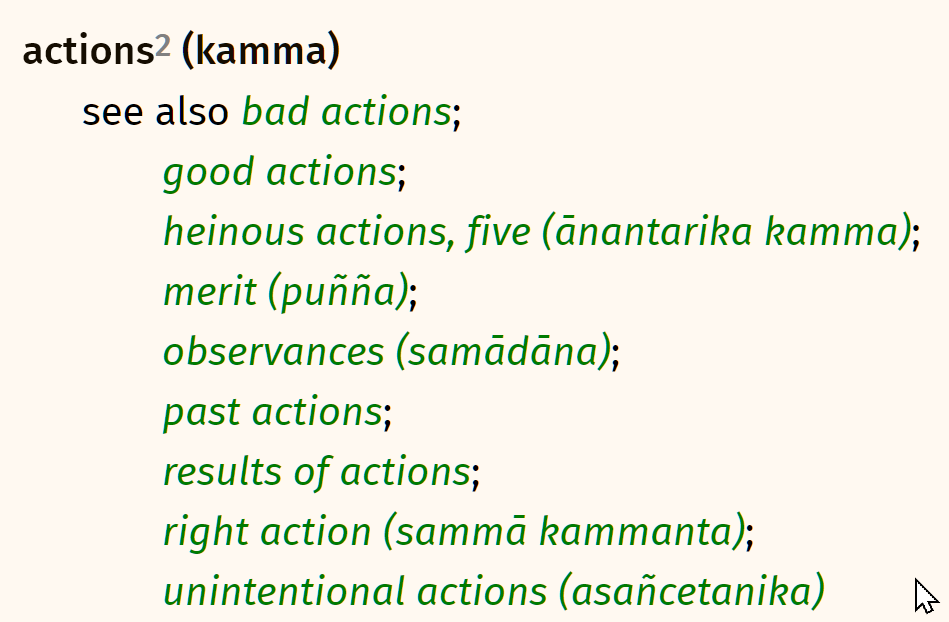
I also have lots of cross refs under actions/kamma:
Without doing that the topic gets to be extremely long. By its nature index work is often about the balance between lumping and splitting.
Right, right. I would agree completely.
Thanks for the feedback Ven!
Yes, could have used vin, good point!
Sorry, just to clarify, are you suggesting I have longer codes than my 1 to 3 character ones? Or are you refering to the explanation (2nd bit) or the longer description (3rd bit)?
I am asking because unless the initial code makes immediate sense to my brain, it adds a second or two, and for every character in the original tag (e.g., ‘4nt’) that means 280,000 extra keyboard presses. That is why I make karma just ‘k’ and rebirth just ‘r’ as I knew I would be typing those a few dozens of thousands of times so keeping it brief!
@HongDa do my codes mean that everyone else will have to use the exact codes, with their brief and longer explanations as well? Also, what happens if I change a code (e.g., from ‘ani’ to ‘til’) in relation to the existing codes? I am reluctant to go back and recode the first 10 as I have already done that twice when I added the additional codes…being selfish here I am afraid
I think ideally the interface you are using to add the tags would be auto completing and making sure you aren’t entering in non-existent tags.
Went back to have a look and yes, I will tag that reference to karma. However, when I looked at the bit I have completed to date, the reference to 32 marks are in DN3 and in that sutta, there is no reference to the 32 marks being due to karma from what I can see…