You’re welcome. My own recommendation, by the way, would be to use one of these three:
1. Philology-based: K. R. Norman
2. Commentary-following: Carter & Palihawadana
3. EBT-informed: Glenn Wallis
Hi,
We have a similar issue of not having easily accessible texts in Nepali language for the general public. I have been very keen to translate the Dhammapada along with commentaries and also Jataka stories for younger audience.
I’ve recently coverted some Dhammapada texts as well as a few background stories to Nepali. I used Dhammapada Commentaries written by Bhante Anandajoti in English from Ancient Buddhist Texts website to translate the stories to Nepali as my Pali is very basic. For the Dhammapada texts I used both the english translations as well as Pali texts to translate to Nepali. Pali language can be similar to Nepali hence I found it useful to use Pali as well.
I had handwritten these translations but have now been able to use Chatgpt to convert the notes into typed texts. I still had to make corrections to the text in MS word.
I’ve also used Chatgpt to generate images based on these converted texts and so far it has done an excellent job.
I did experiment translating quite a few Jataka birth stories from english to nepali using Chatgpt and i thought that it did pretty decent translations. I am having to edit and correct some of the translations but it’s a good place to start and it saves a lot of time and effort.
I especially have to correct some key words and ideas that I want the readers to get a feel for and hopefully understand through the context of the translated texts. As you mentioned the problem in Christianity we have a similar problem due to Hindu culture where some words and ideas are used with a different or wrong meaning.
E.g. Kamma, idea of gods, rebirth, no-soul, impermanence, heaven, hell, 5 precepts, ten wrong views etc
With regards to checking the validity of the translations I’m thinking of sending them to Nepalese Bhikkhus who are well versed in Pali as well as Nepali.
In your case if this is not possible maybe you could cross check it with other Georgians who are versed in teachings of the Buddha.
Dear friends, I’m hopping on this thread a bit late, so pardon me if I miss anything.
That would be great! FYI, most translations go via English, you don’t have to worry about that. This is the case even in better established fields like say Bible translations. Native translations are few, and the overwhelming majority go via English.
This is a whole huge deal!
Just to think it through, if you start with the Dhammapada, it’s not a doctrine heavy text. So you won’t really have to deal with a lot of the doctrinal issues to begin with. On the other hand, it’s poetry, and often quite difficult poetry. So that’s got it’s whole array of problems.
I wouldn’t double-think it all too much: just get started. You’ll find your way.
For myself, I would recommend beginning with the first three discourses: Dhammacakka, Anattalakkhana, and Adittapariyaya. Those three will cover much of the main doctrinal concepts.
OmegaT is a standard Computer Assisted Translation (CAT) app. We don’t use it, we built our own, Bilara, which does the same thing but is specially designed for our texts and systems.
Hi Adarsh. Just to let you know, if you use ChatGPT at all for anything related to your projects they cannot be used on SuttaCentral. We are 100% AI free.
Having said which, we’d absolutely love to have Nepali translations on SC! 
Bandana Dear Bhante,
Thank you for letting me know about this. I have translated some of the Dhammapada sections and typed them myself. However this work is still incomplete. I would be more than happy to translate some suttas from English to Nepali and type them manually. Could you please recommend me some suttas that I could translate for SC.
Great. Well, the best way is to sign up for our Bilara software, then you can translate directly on the web and it’ll be both easy for you and make all the advantages of SC available, especially, your translations will be segmented i.e. line by line, giving readers more options. When you’re ready, they’ll also be eligible for publication in printed book form as well.
If you prefer to work in you own way, that’s fine, you can make the translations and then we’ll convert the files for SC as a “legacy” text. Just no AI at all, ever.
Thank you Bhante
I would like to try the Bilara Software and see if it works for me. Please let me know how i can register for it.
Hello,
You have to register on GitHub and read this guide.
For more details on how to set up a project, click here.
You should message @carmi about this with the relevant details and go from there.
Metta!
Bhante @sujato, you meant no generative AI, right?
From your original AI-free post:
I know the disambiguation is confusing for folks without significant tech experience, but just wanted to double-check, as the difference is relevant in this case, since OCR is not generative.
If I’m understanding correctly, @Adarsh, you were just using ChatGPT solely for converting hand-written notes to digital text, right?
You might be able to use a purpose-built OCR app for that. OCR (Optical Character Recognition) technology pre-dates LLMs by 10+ years and is not “generative” (in brief, it’s more or less a type of classifier). But it is Computer Vision (CV) and a Machine Learning (ML) model, so it is “AI”, but not generative AI (GenAI).
As this is not generative, this should be an acceptable use, right Bhante @sujato?
The terminology has regrettably gotten much more confusing since LLM companies et al have been using the term “AI” very liberally.
I’ve long used OCR to convert text from images into plain text, particularly when I try to help debug an image of code or an error. I normally use Tesseract.js, but it doesn’t support Nepali.
I did find a free OCR web app with no ads for Nepali: https://iocr.olenepal.org/ .
I have no idea how accurate it is though, especially for hand-written text, which is typically more challenging to decipher.
Hi
Yes that is correct. I wanted to translate handwritten Nepali texts to computer typed Nepali texts. However ChatGpt did make some minor changes and I had to manually edit those parts. I did however accept some of these minor changes as i thought the translation was reasonable.
I’ll check out the software you’ve recommended for future text conversions.
Thank you
Indeed yes, and they have been doing so quite deliberately, conflating useful scientific applications of machine learning with genAI.
In this instance, ChatGPT is a genAI tool, so should not be used for anything.
One problem is scope-creep. People say they’re using it for a purpose, and even think they’re using it for a purpose, but what they’re actually doing is quite different.
One of the first conversations I had on AI, with a senior academic, I spoke of how academic papers were being written with AI. They said, that’s not allowed. I’m like, you realize people break rules all the time? Then they mused, “But I use for making an outline. I’m really bad at that.” Umm—that’s using it to write your essay! Outlining is an intrinsic part of writing!
One of the criteria that Torres/Gebru introduce is the notion that safety can only be measured against specific sets of criteria. We can test if a car is safe by driving it into a crash dummy. But we can only test what we can test, and can only foresee what we imagine. In the case of genAI, it has no specific applications or purpose, by its very nature, and can never be tested for safety.
In a discussion on this issue regarding one of my publications, I gave the example to the editor of an acceptable use of AI, Grammarly. That has a limited and specific purpose, to check your grammar and offer suggestions. Even that is dubious, but at least it is specific enough to be tested. The week after I used that example, Grammarly introduced a new feature where they gave you a bunch of “authors” who could check your writing and rewrite it in their style, all AI and all, obviously, without consent of the authors. There was an uproar by the authors and it was rolled back.
And that’s even leaving aside the mountain of other ethical issues with genAI. Which we really shouldn’t.
Anyway, in this case, using OCR is fine, using ChatGPT is not.
Having said which, for preparing texts for publication, better to type them out. The process is where you learn. Going over and over a text, in many different ways, gives you more familiarity and more expertise. It’s not wasted time. Anyway, if you’re making a translation, the proportion of time spent typing is inconsequential.
If you want to, say, look something up in a PDF file or whatever, that’s where OCR is useful.
Dear Bhante @sujato,
For people who are not skilled at typing, can they use Word’s voice-to-text feature?

I’m not sure what you’re asking, do you mean for making translations in Bilara? Because that’s not going to help. Are you suggesting to use Word to speech-to-text, then cut and paste into Bilara???
You know who’s not good at typing? Me. I’m literally typing this with the same three fingers I’ve typed everything else. I know! You know how much difference it makes in the speed of making translations? None whatsoever. Because while you’re typing, you’re also thinking and contemplating and rereading and revising, and these are all essential dimensions of the process.
The rule is, no AI except for specific accessibility issues. So if you’re medically incapable of typing, then you can use specific tools that accomplish that task, like speech to text. Otherwise, do the work.
If this is about typing non-roman characters, then I recognise this is an issue for some people. I know a bhikkhuni who relies on speech to text for that exact reason.
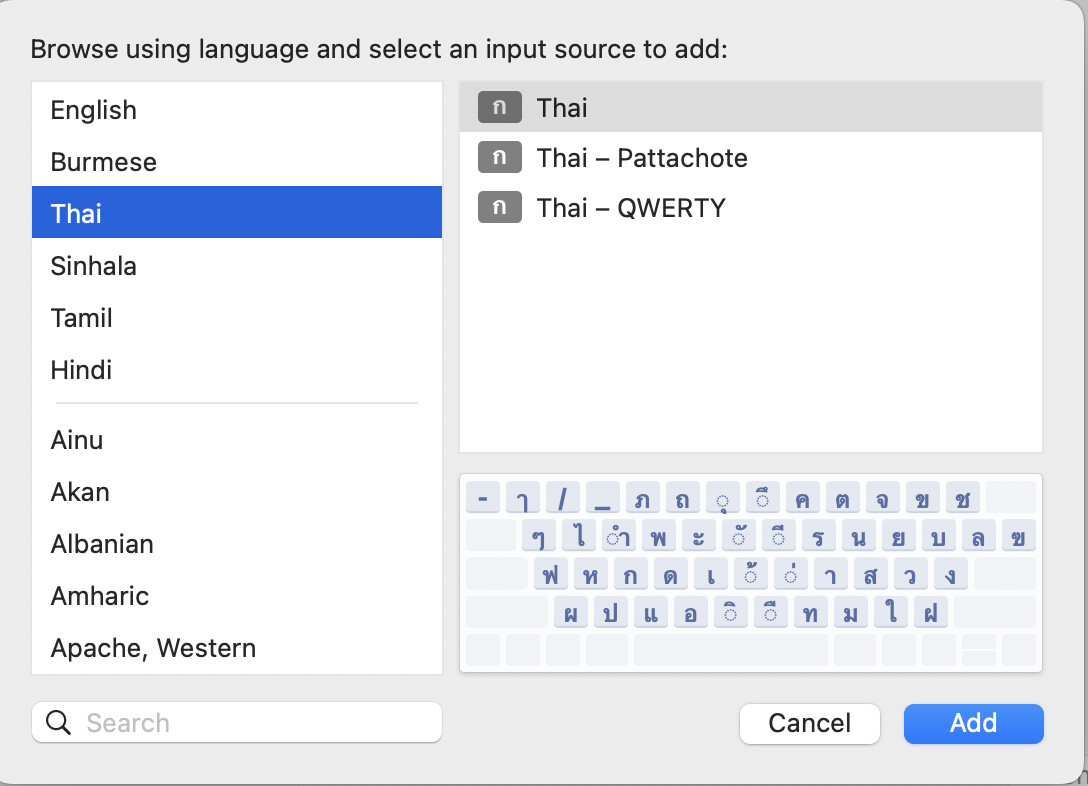
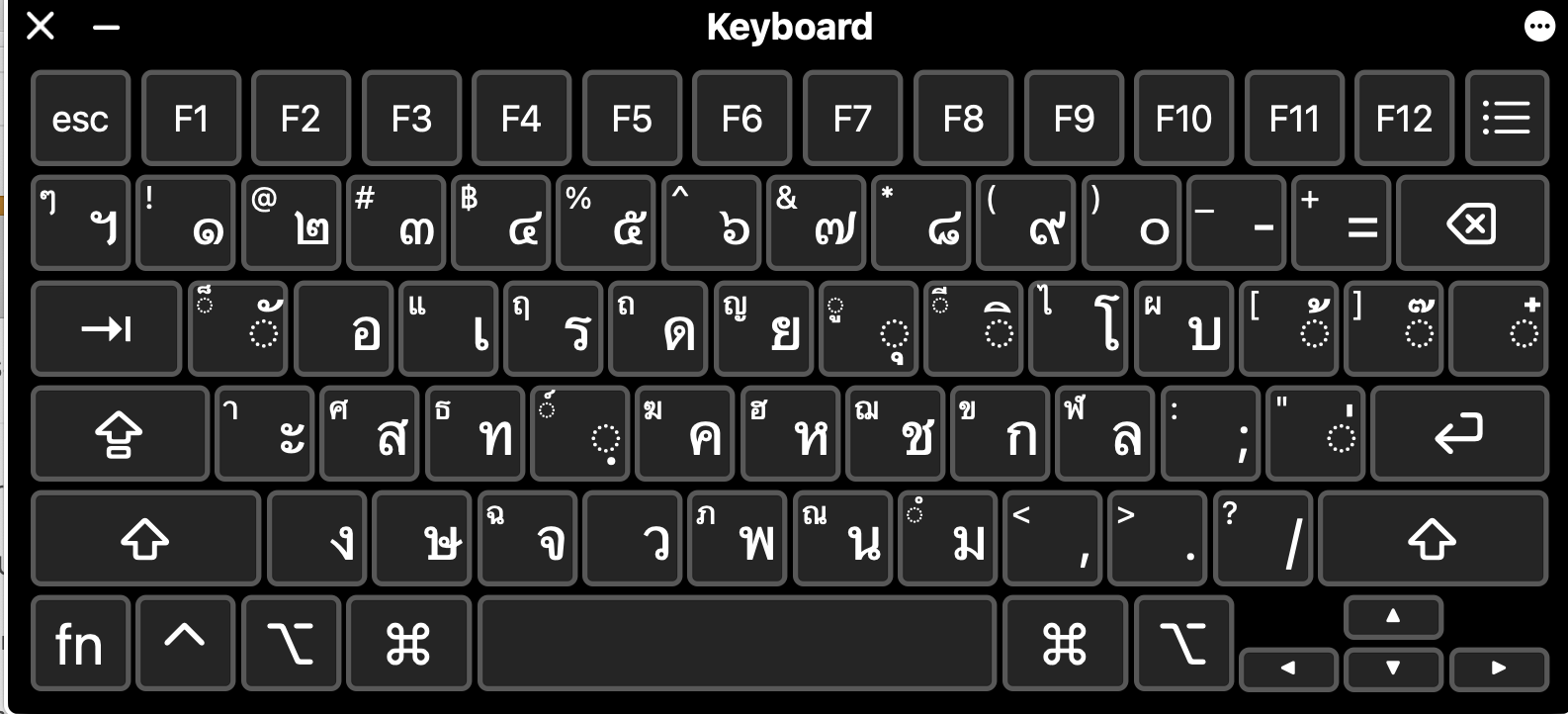
On MacOS you have different options for Thai (and other languages). You can use a traditional Thai layout or use QWERTY style, which would put the characters roughly where the corresponding keys are in English. Shift will toggle for the aspirants (or at least it does in SInhala, I can’t read Thai).
You can have the keyboard up on the screen to help learn key placement too. If you are on Mac and need help setting this up, feel free to reply in a DM.
Thank you, Venerable, for your empathy.
The Thai language has 44 consonant letters, 21 vowel forms, 4 tone marks, and 2 special markers.
I can touch-type English, but I always struggle with Thai, and thus searching the keyboard for letters et al (even with all those forms on it) just disrupts my train of thoughts.
I can see this could be an issue for all sorts of minority languages that use non Roman characters.
Oh okay. Well I get the problem, but I’m going to say that one of the assumed skills of a translator into a language is that they can actually type in that language!
I can, kha, but very slowly. That’s why I like assistance. 
An advantage of working where I worked is that they required high quality rather than speed. When there was an urgent assignment (usually for social media), I usually asked my subordinate to do it and I reviewed her work, saving me time to type.